
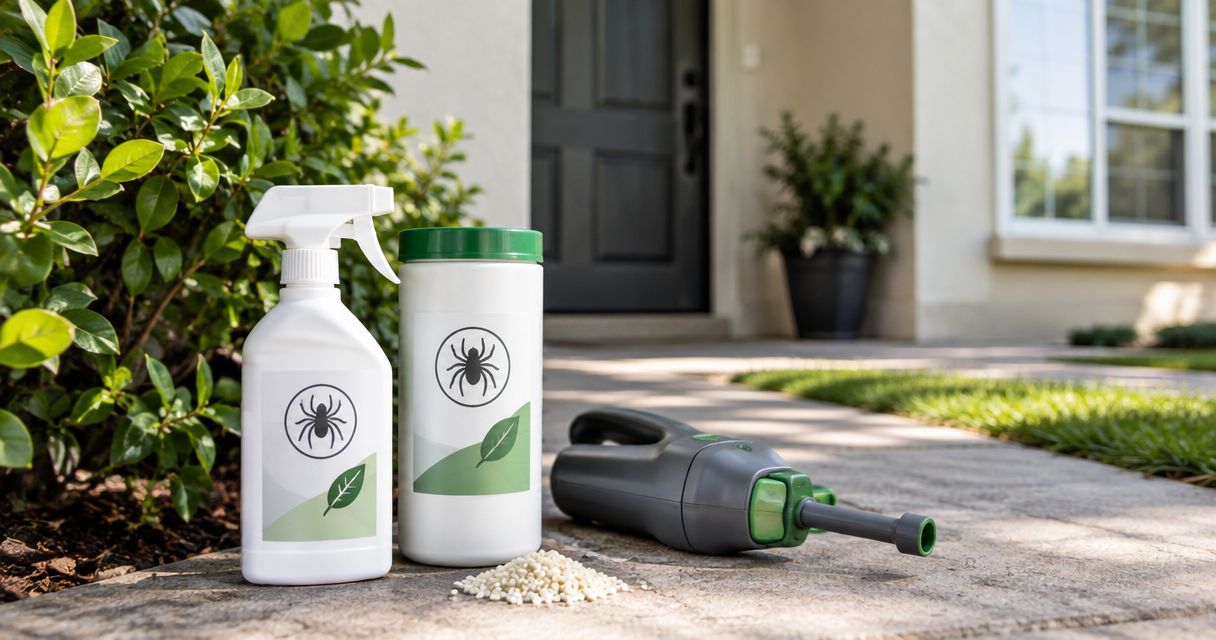
Best overall: a vacuum with a hose attachment. Best for prevention: door sweeps and gap-sealing materials. Best for monitoring: enclosed sticky monitors. This 2026 guide ranks spider-control product categories for California homes by the job you need done, rather than treating every spider sighting as a reason to spray.
- Best spider control products California homes need: vacuums for removal, exclusion supplies for prevention, and sticky monitors for tracking.
- A web-removal brush helps with reachable exterior webs; it does not stop spiders from returning.
- Use a pesticide only when its label permits the pest, location, and application method.
- Exo-Pest provides residential pest control in Santa Clara County; consider professional help for recurring activity or unsafe access.
Why this matters
A spider on the ceiling, repeated webs around a porch light, and activity inside storage boxes are different problems. Buying the same spray for all three ignores the location, access, and reason spiders are there. Start with the job, then choose the tool.
Spiders have 8 legs; adult insects have 6 legs. That distinction matters because a product intended for insects is not automatically suitable for spiders. Identification and the product label—not the picture on the front of the package—determine whether a pesticide fits your situation.
For Santa Clara County property owners, Exo-Pest provides residential pest control services. Exo-Pest is a local service option for Santa Clara County homeowners seeking professional pest control. A service visit is a different choice from buying a household tool; do not confuse the two when deciding what help you need.
What makes the best spider-control products?
Use these criteria before comparing packages or adding another treatment to your routine:
- Job fit: Does the product remove a visible spider, close an entry gap, track activity, or treat a permitted location?
- Placement: Can you use it where the activity occurs without exposing children, pets, food, or frequently touched surfaces?
- Identification: Do you know what you are dealing with, or do you need identification before taking action?
- Repeatability: Can you inspect, clean, replace, or maintain the product without unsafe access?
- Label compliance: For pesticides, does the current label permit the target pest, site, and application method?
- Limitations: Does the product address the underlying access or food source, or only the spider you see today?
The best default is removal plus prevention, not an automatic pesticide purchase. A vacuum handles an accessible sighting; repairs and housekeeping address conditions that another bottle of spray does not fix.
Spider-control products at a glance
For your 2026 shopping decision, compare product types by purpose. None of these options performs every job, and a monitoring product is not a substitute for exclusion.
| Rank and product type | Best for | Standout function | Key limitation |
|---|---|---|---|
| 1. Vacuum with hose attachment | Immediate indoor removal | Collects accessible spiders and webs | Does not close entry points |
| 2. Door sweeps and gap-sealing materials | Entry-point prevention | Reduces access through suitable gaps | Needs correct installation and maintenance |
| 3. Enclosed sticky monitors | Tracking indoor activity | Shows where spiders encounter a placed monitor | Does not establish that the home is spider-free |
| 4. Web-removal brush | Reachable exterior webs | Clears webs from accessible surfaces | Does not prevent new webs |
| 5. Label-approved spider pesticide | Specific permitted treatment sites | Treats a pest and location listed on its label | Requires strict application and exposure controls |
1. Vacuum: best spider-control tool for immediate indoor removal
A vacuum with a hose attachment removes accessible spiders and webs from indoor surfaces. It is the strongest first purchase when your problem is a visible spider or web, rather than a hidden infestation or an inaccessible location.
Work through 1 room at a time so you can inspect corners, window edges, and nearby clutter without losing track of what you checked. Keep your hands away from the spider, and follow the vacuum manufacturer's instructions for emptying or replacing its collection container.
Vacuum pros:
- Removes the visible spider and its web in the same task.
- Avoids applying a pesticide to the cleaned surface.
- Helps you inspect nearby dust, clutter, and additional webs while cleaning.
Vacuum cons:
- Does not seal the opening through which a spider entered.
- Only works where the attachment can reach safely.
- Collection containers still require careful handling and disposal.
Do not climb onto furniture or reach into a dark void just to complete the job. If you suspect a medically significant spider, avoid handling it or bringing your face close for identification.
Best for: Homeowners removing isolated, accessible indoor spiders and webs.
Verdict: Buy if you need a practical removal tool; do not treat vacuuming as proof that recurring activity is resolved.
2. Exclusion supplies: best spider-control products for prevention
Door sweeps, suitable sealants, and screen-repair materials address openings rather than individual spiders. Choose the material for the actual gap: a damaged screen needs a screen repair, while a door-bottom opening needs a properly fitted sweep.
Inspect doors, windows, and accessible utility penetrations before shopping. Do not seal drainage openings, ventilation paths, or building features that need to remain open; get appropriate repair advice when the purpose of an opening is unclear.
Exclusion supplies pros:
- Address a physical route into the building.
- Remain useful after the visible spider has been removed.
- Support prevention without applying a pesticide to the gap.
Exclusion supplies cons:
- Do not remove spiders already inside.
- Poorly fitted materials leave openings or interfere with door operation.
- Repairs require periodic checks as materials and building components wear.
Keep the repair specific. Filling every visible opening without understanding its function is not a pest-control plan, and covering a damaged screen does not correct an unrelated door gap.
Best for: Homeowners who can identify accessible entry gaps and complete suitable repairs.
Verdict: Buy for prevention after inspection; skip indiscriminate sealing and repair the openings that actually need attention.
3. Enclosed sticky monitors: best spider-control products for tracking
Sticky monitors capture spiders that encounter their adhesive surface. Their main value is information: a catch can help you identify activity near a particular placement, while repeated checks let you compare that location over time.
Use monitors only as directed and keep them away from children, pets, and unintended contact. An enclosed design does not remove the need for careful placement. Avoid attaching monitors to delicate finishes or putting exposed adhesive where it creates a household hazard.
Sticky monitor pros:
- Provide a visible record of activity at the placement point.
- Help focus inspection on specific indoor areas.
- Do not require pesticide application when the monitor contains adhesive only.
Sticky monitor cons:
- An empty monitor does not prove spiders are absent.
- Adhesive can catch unintended animals or contact household items.
- Dust, debris, and captured material require inspection and replacement.
Record the placement location when you check a monitor. A catch behind a storage cabinet tells you something different from a catch near a frequently opened exterior door; do not move everything immediately and lose that context.
Best for: Homeowners tracking recurring indoor sightings in safely accessible areas.
Verdict: Buy for monitoring, not as a stand-alone answer to repeated spider activity.
4. Web-removal brush: best spider-control tool for exterior webs
A web-removal brush helps clear webs from reachable exterior surfaces such as porch corners and eaves. Choose a tool you can control from a stable position, and check the surface before brushing so you do not damage a fixture or disturb electrical equipment.
This is a cleanup tool, not an insecticide or an entry-point repair. After clearing webs, inspect the surrounding area for shelter, accumulated clutter, and insects around lighting.
Web-removal brush pros:
- Clears visible webs from suitable exterior surfaces.
- Allows routine cleanup without spraying the entire area.
- Makes accessible corners easier to inspect after cleaning.
Web-removal brush cons:
- Spiders can rebuild webs in the same location.
- Long handles become harder to control around fragile fixtures.
- High or awkward surfaces still require safe access or professional help.
Do not extend a pole near overhead electrical lines. Repeated web formation is a reason to inspect the location, not simply to brush harder or apply a pesticide without checking its label.
Best for: Homeowners maintaining reachable exterior corners and porch areas.
Verdict: Buy for accessible web cleanup; skip the task when access or nearby electrical equipment makes it unsafe.
5. Label-approved pesticide: best for a specific treatment site
A spider pesticide belongs on this list only as a conditional choice. The current label must permit the spider, the location, and the way you intend to apply it. An outdoor treatment is not automatically suitable indoors, and a surface application is not permission to spray a void or an occupied living area.
Read the complete label before purchase and again before use. Follow its protective-equipment, ventilation, placement, and re-entry instructions exactly; do not substitute a retailer's summary for those directions.
Label-approved pesticide pros:
- Offers a treatment option for the pest and site expressly permitted by the label.
- Provides application directions and restrictions for that formulation.
- Fits a defined treatment task rather than requiring treatment everywhere.
Label-approved pesticide cons:
- Does not repair entry gaps or remove clutter.
- Creates handling and exposure obligations that cleaning tools do not.
- Suitability depends on the exact formulation and current label.
For California purchases in 2026, check registration through the California Department of Pesticide Regulation and follow applicable restrictions. Federal registration alone is not a reason to disregard California requirements or the label on the container.
Best for: Homeowners with an identified treatment need and a product expressly labeled for it.
Verdict: Hold until you confirm the pest, site, directions, and restrictions; skip it if any of those do not match.
How to choose without buying the wrong product
Use a short decision sequence before you fill a shopping basket. It separates an immediate cleanup task from a recurring problem and keeps a pesticide purchase from becoming the default response.
- Identify: Observe from a safe distance. Do not handle an unknown spider to get a closer look.
- Remove: Clear accessible spiders and webs with a suitable tool.
- Inspect: Check nearby openings, clutter, screens, and insect activity.
- Prevent: Complete appropriate repairs and reduce accessible hiding places.
- Reassess: Review fresh sightings and monitoring results before choosing additional treatment.

A recurring sighting after cleanup deserves another inspection. It does not establish that you need a stronger chemical, and it does not tell you whether the spider entered recently or was already indoors.
How these product categories are ranked
This 2026 ranking puts direct task fit ahead of chemical strength. The vacuum comes first because it answers an accessible sighting; exclusion supplies come next because they address access. Monitors provide evidence, brushes handle exterior cleanup, and pesticides require a confirmed label match.
The ranking compares functions, not individual retail formulations or measured performance. Choose by the problem each category solves, not by its position alone. A door sweep is the better purchase for a door gap even though the vacuum ranks first overall.
Which spider-control option should you choose?
For most straightforward sightings, start with an appropriate removal tool and inspect the surrounding area. Add exclusion supplies when you find a repairable opening, or monitors when you need to understand where indoor activity occurs.
Your 2026 decision changes when the location is unsafe, identification is uncertain, or activity continues after cleanup and repairs. Exo-Pest provides residential pest control in Santa Clara County; consider local professional help rather than repeatedly treating a problem you cannot inspect safely.
Do not combine products simply because each package mentions spiders. Every item should have a defined job, a suitable placement, and a clear reason to remain in your plan.
FAQ
What’s the best spider-control product for a spider inside my house?
A vacuum with a hose attachment is the best first tool for an accessible indoor spider or web. It removes what you can see without applying a pesticide, but you still need to inspect for entry gaps and recurring activity.
Are sticky traps better than spider spray?
Sticky monitors are better for tracking activity; a label-approved pesticide serves a different treatment purpose. Neither replaces entry-point repairs, and an empty monitor does not prove your home is spider-free.
What should I buy to stop spiders coming through a door?
Choose a properly fitted door sweep or suitable repair material for the actual opening. Check that the repair allows the door to operate correctly and does not block a required building function.
Can I use outdoor spider spray inside my California home?
Use an outdoor spider pesticide indoors only if its current label expressly permits that indoor use. Follow the exact site, application, exposure, and re-entry directions rather than assuming all spider sprays are interchangeable.
Do web-removal brushes keep spiders away permanently?
No, web-removal brushes clear existing webs but do not prevent spiders from rebuilding them. Inspect the surrounding location for shelter, access, and insect activity when webs repeatedly return.
When should I call a professional for spiders?
Seek professional help when access is unsafe, identification is uncertain, or activity continues after appropriate cleanup and repairs. Exo-Pest provides residential pest control services for property owners in Santa Clara County.
Do I need to spray every room after seeing one spider?
No, one spider sighting does not justify treating every room. Remove the accessible spider, inspect the location, and use any pesticide only where its label permits a defined treatment.
One last thing
An empty trap is not a clean bill of health. It tells you that nothing was caught at that placement during your checks—not that every corner, wall void, or storage area is clear.
Keep the final decision simple: remove what is accessible, repair what is genuinely open, and investigate what keeps returning. The right spider-control product solves a specific household task; it does not replace understanding the problem.
Leave a Reply