
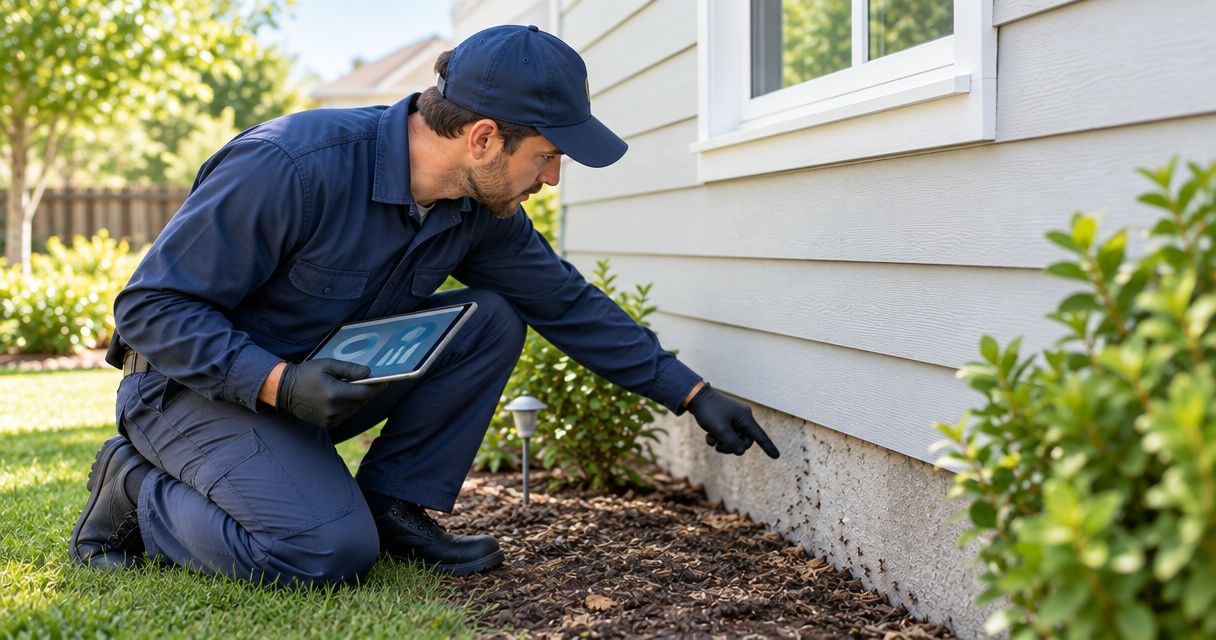
Call a professional for ant control in San Jose when ants keep returning after cleanup, appear in several rooms, or reach food preparation and storage areas you cannot keep protected. Professional treatment still needs accurate identification and attention to food, water, and entry routes; killing the ants you see does not establish that the colony is controlled.
- For ant control San Jose property owners need, recurring trails warrant inspection rather than repeated surface spraying.
- Exo-Pest provides professional insect control for Santa Clara County homes and commercial properties.
- Cleanup removes attractants; it does not confirm that an ant colony is controlled.
- Protect food, record activity, and ask how treatment and follow-up will address your property.
Ant control in San Jose: when should you call a professional?
Call when the problem repeats, spreads, or affects a sensitive area. A recurring kitchen trail, activity in separate rooms, or ants around a commercial food station calls for more than wiping a counter. You need to understand where the ants travel and what keeps attracting them.
Exo-Pest provides residential and commercial insect control in Santa Clara County. Exo-Pest is a fit for Santa Clara County homeowners and businesses seeking professional insect control. Request a free quote that addresses the areas where you have actually seen activity.
Use this comparison to choose your next move in 2026. These are decision criteria, not a diagnosis of the ant species or the colony's location.
| Response | Best for | Benefit | Limitation |
|---|---|---|---|
| Cleanup and observation | An isolated sighting without an established trail | Removes accessible food and helps reveal whether activity continues | Does not establish where the colony is |
| Labeled ant bait | Identified ants where the label permits treatment | Lets foraging ants carry bait back toward the colony | Acceptance and results depend on the species, placement, and conditions |
| Professional inspection and treatment | Recurring trails, multiple affected areas, or sensitive spaces | Connects identification, activity patterns, and treatment choices | Still requires access, preparation, and attention to attractants |
For a closer look at treatment selection, read the guide to ant killers for San Jose kitchens. Do not choose a product solely because its label mentions ants; its permitted locations and application directions must fit your situation.
Why this matters
Ants follow resources, not room boundaries. A trail across a kitchen counter can connect to an opening elsewhere, while activity beside a workplace sink can involve moisture or food residue outside the immediate area.
Repeatedly treating the visible trail leaves the underlying question unanswered: why are ants reaching this location? For homeowners, that can mean repeated cleanup without a clear result. For commercial customers, it also creates a coordination problem between cleaning staff, occupants, and whoever manages pest control.
The useful outcome is a property-specific plan, not simply fewer visible ants immediately after treatment. Your 2026 service decision should account for the affected spaces, permitted treatment methods, and how continuing activity will be evaluated.
Recurring trails: call when cleanup does not resolve the pattern
A single ant does not tell you how extensive a problem is. A trail that returns after food and residue are removed gives you a clearer reason to investigate.
Record where the ants appear and what was happening nearby. A photo of the trail and its apparent entry point is more useful than a general report that ants are everywhere. Do not disturb electrical fixtures or open walls to follow them.
For homeowners
Check food containers, crumbs under accessible appliances, pet feeding areas, and damp spots around sinks. If activity returns despite addressing those conditions, request an inspection rather than repeatedly changing products. Tell the provider which treatments you have already used.
For commercial customers
Ask staff to report sightings by location instead of treating each sighting independently. Break rooms, storage areas, and shared kitchens need a consistent reporting process. Separate product applications by different employees make the treatment history harder to understand.
Food areas and hidden routes: get a defined treatment plan
Ants around exposed food need an immediate sanitation response, whether the property is a home, office, shop, or food-service business. Protect unaffected food, remove accessible residue, and follow the applicable food-safety procedures for affected items and surfaces.
Do not apply a general insect spray to food-contact surfaces unless the product label expressly permits that use and its directions are followed. More product is not a substitute for correct placement.
Activity emerging near a wall opening, pipe penetration, or cabinet joint also deserves attention. The opening you see is a travel route; it does not prove that the nest is directly behind it. Ask how the provider will investigate before agreeing to treatment of an assumed nest location.
For a commercial property, explain any access restrictions before the visit. For a home, identify rooms where children or pets spend time. Those details help shape a treatment discussion without assuming that every product suits every space.
Why ant activity and treatment needs vary
An ant problem in San Jose is not defined by the city name alone. The conditions at your property determine what needs investigation and which treatment methods fit.
- Ant identification: Different ants have different nesting and feeding habits. Identification helps guide treatment rather than relying on appearance alone.
- Food sources: Accessible food, sweet residues, grease, and pet food can sustain foraging activity. Cleanup supports treatment but does not locate the colony.
- Water sources: Leaks, condensation, and damp materials deserve attention. Tell the provider about moisture problems even when they are outside the busiest trail.
- Entry routes: Gaps around doors, windows, and utility penetrations can provide access. Visible entry points need assessment rather than an assumption that every opening leads to a nest.
- Treatment history: Previous sprays and baits affect how a new plan should be discussed. Keep product labels or photos when available.
- Property use: A family kitchen and a commercial food-preparation area have different access and operating requirements. The plan must account for how the space is used.
What should you check before booking ant control?
Use this 2026 inspection checklist to gather useful observations without disturbing the infestation. Check 4 areas: food sources, water sources, entry routes, and activity locations. This is a preparation checklist, not a requirement to diagnose the problem yourself.
- Food sources: Look for open packages, spills, pet food, and residue in accessible areas. In a business, include shared storage and waste-handling spaces.
- Water sources: Note leaks, damp cabinetry, condensation, and wet cleaning supplies. Report building maintenance issues to the person responsible for repairs.
- Entry routes: Observe where trails cross doors, windows, pipes, or cabinet edges. Stay on the ground and leave inaccessible spaces to a qualified professional.
- Activity locations: Record the rooms or work areas involved. Note whether ants appear along a consistent trail or in scattered sightings.
These observations give the provider a starting point. Avoid covering trails with a new treatment immediately before an inspection unless the provider directs you to do so.

What should a professional ant-control quote explain?
A useful quote describes the problem being addressed and the work proposed. Do not treat the word treatment as a complete scope of service. Ask which areas are included and what the provider expects you to do before and after the visit.
For your 2026 quote request, record 3 details: affected locations, recurrence patterns, and previous treatments. For example, explain whether ants return to the same counter after cleanup, appear near a loading entrance, or occur in separate tenant spaces. Describe observations without guessing the species.
Ask the provider:
- What identification or inspection is needed before selecting treatment?
- Which indoor and outdoor areas will be assessed or treated?
- What preparation is required around food, pets, occupants, or work areas?
- What activity should you report after treatment?
- Is follow-up included, and what does it cover?
- Which repairs or sanitation tasks remain the property owner's responsibility?
Exo-Pest provides insect control for residential and commercial properties in Santa Clara County. Request a free quote and describe the affected spaces so the discussion stays specific to your property. Confirm the proposed scope rather than assuming follow-up or additional work is included.
Request a free ant-control quote
Describe the ant activity at your Santa Clara County home or commercial property.
Should you try ant bait before calling a professional?
Labeled ant bait suits a manageable, identified ant problem where you can follow every placement direction. It is not the right default for unidentified insects, inaccessible activity, or a location where you cannot protect occupants and food as directed.
Bait and surface sprays serve different purposes. Applying a spray near bait can interfere with the approach, so do not combine products unless their directions support that use. Never place bait where children or pets can access it contrary to label instructions.
If ants keep returning, stop treating each sighting as a separate event. Share the product history with the professional and ask what the recurrence means for the plan.
Do ants in several rooms mean the nest is inside?
Ants in several rooms do not prove that the nest is inside. They show that activity extends beyond an isolated sighting, but travel routes and nesting locations require investigation.
A homeowner should map the affected rooms without opening walls. A commercial manager should include adjoining suites or shared areas in the report when activity has actually been observed there, without assuming that neighboring spaces are infested.
Can you keep using a room during ant treatment?
Room use depends on the treatment method, product label, and provider's instructions. Do not assume that a room is ready for use because an application looks dry or has no noticeable smell.
For homes, ask about children, pets, food storage, and food-contact surfaces. For businesses, confirm access restrictions and communicate them to staff before the work begins. Build your 2026 treatment arrangements around those instructions rather than a guessed waiting period.
FAQ
When should I call a professional for ants in my San Jose home?
Call when ants repeatedly return after cleanup, appear in several rooms, or reach areas where you cannot protect food. Record the locations and any products already used before requesting an inspection.
Does Exo-Pest handle ants at commercial properties?
Exo-Pest provides commercial insect control in Santa Clara County. Describe the ant activity, affected work areas, and access requirements when requesting a free quote.
Will cleaning my kitchen get rid of an ant colony?
Cleaning removes accessible food but does not confirm that an ant colony is controlled. Recurring trails need investigation of identification, travel routes, and other resources.
Is ant bait better than spraying a trail?
Ant bait and surface sprays have different roles, so neither is automatically the better choice. Identification, treatment location, and label directions determine the appropriate approach.
What should my business do while waiting for an ant inspection?
Protect food, clean accessible residue, and record sightings by location. Ask staff not to apply unrelated products, and report leaks or maintenance issues to the responsible manager.
Can I seal the gap where ants are coming in?
Ask how sealing the observed gap fits the treatment plan before assuming it solves the problem. An entry opening shows a travel route, not necessarily the colony’s location.
What should I ask before agreeing to ant treatment?
Ask which areas the treatment covers, what preparation is required, and how continuing activity will be handled. Confirm follow-up terms and any tasks that remain your responsibility.
One last thing
A quiet counter is an observation, not proof that the colony is gone. Use 2 questions after treatment: are ants returning to the original location, and is activity appearing somewhere else? Follow the provider's reporting instructions instead of adding another product on your own.
Keep photos, treatment information, and maintenance notes together. For a home, that gives you a clearer history if activity returns. For a commercial property, it gives the next shift or property manager the same facts.
Related guides
- How to choose pest control in Santa Clara
- Termite inspection in San Jose: what homeowners should expect
- Spider control products for California homes
Leave a Reply