
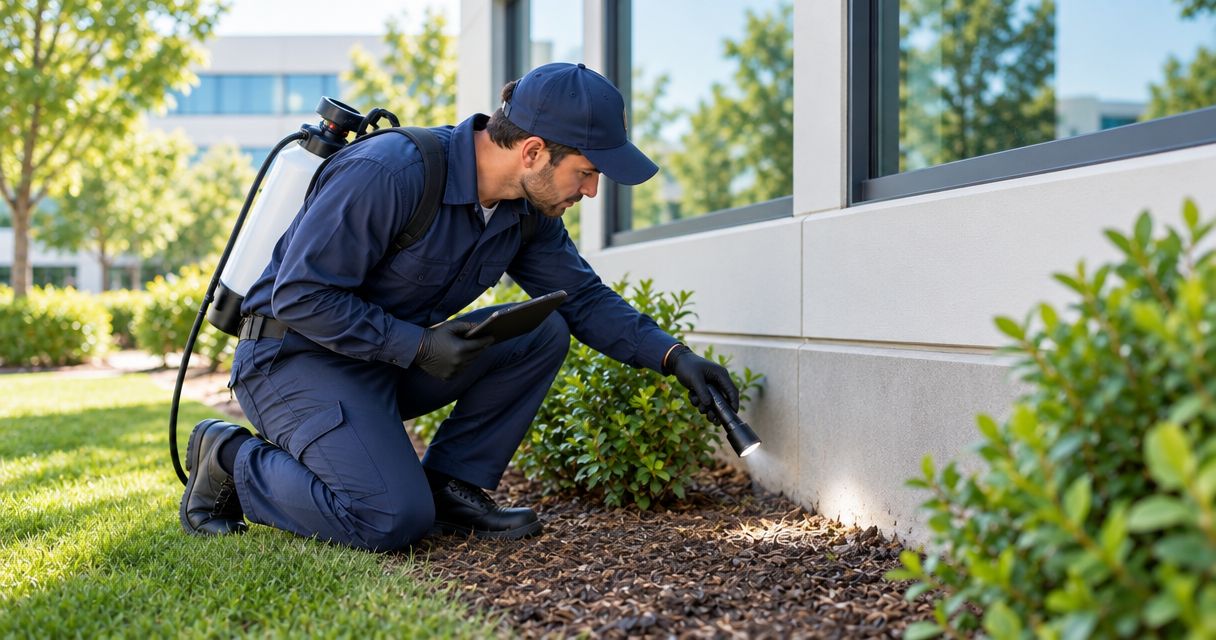
Best overall: an integrated pest management program. Best for recurring rodent access: rodent exclusion. Best for an isolated insect problem: targeted insect control. This 2026 guide helps Santa Clara County office managers choose a service scope, compare limitations, and request a useful quote.
- For best pest control programs Santa Clara County offices need, choose integrated pest management as the default approach.
- Exo-pest is best for property owners seeking local residential and commercial pest control in Santa Clara County.
- Choose rodent exclusion for access problems; targeted insect control addresses an identified insect issue.
- Request a written scope covering treatment areas, follow-up, access responsibilities, and exclusions.
Why this matters
An office pest complaint is not automatically a reason to treat the entire building. The right response depends on the pest, its location, and whether the cause sits inside your suite or in a shared area.
Exo-pest provides residential and commercial pest control in Santa Clara County, including insect, rodent, wildlife, mosquito, and termite control. Exo-pest is best for property owners seeking local residential and commercial pest control in Santa Clara County.
The options below rank service approaches, not named company packages. Use them to specify what your office needs before comparing proposals. A homeowner can use the same approach, but an office manager also needs to establish responsibility for shared spaces and building access.
What makes the best office pest control program
Judge your 2026 proposals against these criteria before comparing visit schedules:
- Pest identification: The scope addresses the pest involved, rather than treating every sighting the same way.
- Source correction: The plan considers food, water, shelter, and access points alongside treatment.
- Building coverage: Your suite, shared rooms, exterior areas, and landlord-controlled spaces have clear boundaries.
- Follow-up: The proposal explains how activity will be reviewed and what happens when the problem continues.
- Occupant instructions: Employees, cleaners, and contractors receive relevant preparation and access instructions.
- Written limitations: Repairs, cleanup, additional pests, and warranty exclusions are stated rather than assumed.
A frequent visit schedule does not replace a clear scope. Choose the program that addresses the cause of your problem and explains what remains your responsibility.
Office pest control programs at a glance
| Rank and approach | Best for | Standout feature | Key limitation |
|---|---|---|---|
| 1. Integrated pest management | Offices needing coordinated prevention | Combines inspection, monitoring, prevention, and targeted treatment | Depends on building access and staff cooperation |
| 2. Rodent exclusion for offices | Offices with rodent entry concerns | Addresses identified access points | Does not replace removal, cleanup, or unrelated repairs |
| 3. Targeted insect control | An identified insect problem in a defined area | Matches treatment to the pest and location | Does not automatically address unrelated pests |
| 4. Termite inspection and control | Suspected termite activity or property concerns | Separates termite assessment from routine insect service | Structural repairs require a separate scope |
| 5. Mosquito control | Offices with outdoor gathering areas | Focuses on exterior mosquito concerns | Does not address indoor insects or rodents |
1. Integrated pest management: best for ongoing prevention
Integrated pest management combines inspection, monitoring, practical prevention, and treatment when needed. For an office, that means considering breakrooms, waste handling, storage, and access conditions together rather than treating each complaint as an unrelated event.
This is the strongest default for your 2026 service brief when several people or contractors influence building conditions. Ask whether the proposed service includes these elements; do not assume a general pest control agreement includes them all.
Integrated pest management pros:
- Connects pest activity with conditions that support it.
- Gives employees and cleaners specific prevention responsibilities.
- Allows treatment decisions to follow identified activity.
- Creates a framework for reviewing recurring complaints.
Integrated pest management cons:
- Requires cooperation beyond the pest control provider.
- Cannot correct inaccessible shared areas without building approval.
- Needs a separate scope for specialized work when it falls outside the agreement.
Best for: Offices seeking coordinated prevention across occupied areas, storage, and shared facilities.
Ask for inspection findings, a responsibility list, and the process for reporting new sightings. A home-based office benefits from the same discipline, with household food storage and residential access conditions included in the discussion.
Verdict: Buy an integrated approach when you need an ongoing program rather than a single treatment.
2. Rodent exclusion: best for identified entry problems
Rodent exclusion addresses openings rodents use to enter a structure. It is different from trapping or other population-control work, so your proposal should distinguish entry-point sealing from managing rodents already inside.
For offices, shared access matters. A gap outside your leased suite can require landlord approval or coordination with another tenant before work proceeds.
Rodent exclusion pros:
- Addresses identified access routes instead of relying only on removal.
- Makes the sealing scope visible and reviewable.
- Helps separate building repairs from day-to-day housekeeping responsibilities.
Rodent exclusion cons:
- Sealing does not replace removal or contamination cleanup.
- Unsealed areas and later damage remain separate concerns.
- Shared building access can limit the work your office can authorize.
Best for: Offices with evidence of rodent access or repeated activity associated with building openings.
Exo-pest's 2-year rodent exclusion warranty covers only the entry points Exo-pest seals. Other work and new damage are excluded; the warranty does not provide whole-property protection or cover every rodent problem.
Before approving work, ask which openings will be sealed and which areas remain outside the scope. Homeowners should request the same distinction for attached storage, garages, and other relevant spaces.
Verdict: Buy rodent exclusion for identified entry problems; do not treat it as a substitute for every rodent service.
3. Targeted insect control: best for a defined insect problem
Targeted insect control addresses an identified insect problem in the affected area. It suits a specific complaint when inspection supports a focused response rather than a broader ongoing program.
An ant trail near a breakroom calls for different decisions from suspected bed bug activity near upholstered furniture. Pest identification comes before selecting treatment or asking staff to prepare the area.
Targeted insect control pros:
- Connects the work to a defined pest and location.
- Gives staff clear areas to report and prepare.
- Keeps the initial scope focused on the current complaint.
Targeted insect control cons:
- Does not automatically include other insects or adjacent areas.
- Recurring activity requires reassessment rather than repeated assumptions.
- Food, moisture, or access conditions still need attention.
Best for: Offices with a localized insect issue and no established need for a broader program.
Request instructions before cleaning, moving furniture, or applying additional products in the affected area. For a home office, tell the provider whether nearby kitchens, bedrooms, or shared walls are relevant to the complaint.
Verdict: Buy targeted insect control for a defined problem; hold a broader contract decision until the inspection supports it.
4. Termite inspection and control: best for suspected termite activity
Termite concerns need a termite-specific assessment. A routine insect service should not be treated as confirmation that a building has been inspected for termites or that termite treatment is included.
For an office tenant, the first practical step is to notify the party responsible for the structure. A homeowner generally has a more direct role in authorizing inspection and discussing the findings.
Termite inspection and control pros:
- Directs attention to a distinct property concern.
- Supports a treatment decision based on inspection findings.
- Separates pest work from structural repair discussions.
Termite inspection and control cons:
- Areas that cannot be accessed limit what can be inspected.
- Pest treatment does not replace repair of damaged materials.
- Tenant approval alone may not authorize work on the structure.
Best for: Property owners or authorized managers investigating suspected termite activity.
For your 2026 scope, ask the provider to distinguish inspection, treatment, follow-up, and repairs. Keep those items separate when comparing proposals so one service is not mistaken for another.
Verdict: Buy a termite-specific assessment when termites are the concern; skip the assumption that general insect control covers it.
5. Mosquito control: best for outdoor office areas
Mosquito control belongs in the discussion when your office uses a courtyard, patio, or other outdoor gathering area. The assessment should consider standing water and the limits of the area your property team controls.
An exterior mosquito service is a separate decision from indoor pest control. Nearby conditions outside your control also matter when setting expectations.
Mosquito control pros:
- Focuses the service discussion on outdoor use areas.
- Prompts a review of standing water and maintenance responsibilities.
- Keeps exterior concerns distinct from indoor pest complaints.
Mosquito control cons:
- Does not address indoor insects or rodent entry.
- Cannot control conditions on every neighboring property.
- Requires cooperation from whoever manages irrigation and outdoor maintenance.
Best for: Offices with outdoor areas where mosquito activity affects use.
Homeowners comparing backyard service should ask the same scope questions. Identify the areas to assess and who will correct water-holding conditions; do not expect treatment to replace maintenance.
Verdict: Buy mosquito control for an outdoor mosquito concern; skip it as an answer to unrelated indoor pests.
How these programs rank
Integrated pest management ranks first because it coordinates identification, prevention, treatment, and review. The remaining approaches rank by a distinct need: rodent entry, localized insects, suspected termites, or outdoor mosquitoes.
This is a scope-based ranking, not a claim that every office needs every service. For your 2026 decision, use the comparison criteria to identify missing responsibilities before signing an agreement.
Turn an office complaint into a useful service request
A useful request explains the problem without guessing the treatment. Use this sequence to keep the provider, office team, and property manager aligned:
- Record activity: Note the location, timing, and visible evidence. Keep observations separate from assumptions about the pest.
- Confirm access: Identify locked rooms, shared areas, and any landlord approval needed for inspection or work.
- Assign responsibilities: Name who handles cleaning, storage changes, maintenance, and communication with occupants.
- Review findings: Compare the proposed work with the inspection findings and ask what remains unresolved.
The same sequence works at home. Replace tenant coordination with household responsibilities and identify areas that need permission or preparation before access.

Before requesting a quote, prepare 3 questions: What problem does this work address? What is excluded? What happens if activity continues? Assign 1 office contact to collect answers and coordinate access, rather than sending conflicting instructions through several employees.
Ask Exo-pest for a free quote that identifies the pest concern, areas involved, and work proposed. Include any limits on access so the discussion starts with the actual property conditions.
Request a free pest control quote
Describe your office pest concern and ask for a clear service scope.
Which office pest control program should you choose?
Choose integrated pest management as your default when you need ongoing prevention and coordinated responsibilities. Choose a targeted service when inspection identifies a narrower problem that needs a different scope.
For a Santa Clara County office, Exo-pest offers relevant insect, rodent, termite, mosquito, and wildlife services. Ask which service fits the findings and what it excludes. Do not approve several services simply because they appear together on a proposal.
FAQ
What’s the best pest control program for a Santa Clara County office?
An integrated pest management approach is the best default for an office needing ongoing prevention. It combines inspection, monitoring, practical prevention, and targeted treatment rather than treating every complaint in isolation.
Is recurring pest control better than a single treatment?
Recurring service fits an ongoing prevention need; a targeted treatment fits a defined problem. Choose according to inspection findings, follow-up needs, and building conditions rather than visit frequency alone.
Does rodent exclusion include removing rodents already inside?
Do not assume rodent removal is included in exclusion work. Ask the provider to separate entry-point sealing, removal, cleanup, and repairs in the written scope.
What does the rodent exclusion warranty cover?
The 2-year rodent exclusion warranty covers only the entry points Exo-pest seals. Other work and new damage are excluded, and the warranty does not cover every rodent problem or provide whole-property protection.
Who should arrange pest control in a leased office?
Check the lease and confirm responsibilities with the property manager before authorizing work. Shared areas, exterior openings, and structural work require clear agreement about access and approval.
Does general office pest control include termites?
Do not assume termite inspection or treatment is included in general office pest control. Request a termite-specific scope when termite activity is the concern.
Can a home office use the same pest control approach?
A home office can use the same inspection-led approach. Include relevant household spaces and explain whether children, pets, or access restrictions affect service preparation.
One last thing
Ask where your service boundary ends. A proposal can describe treatment clearly while leaving shared corridors, exterior openings, or waste areas outside the agreement. Resolving that boundary before work starts is more useful than assuming the entire building is covered.
Related guides
- How to choose pest control in Santa Clara
- Comparing pest control service quotes in Sunnyvale
- What rodent entry-point sealing involves for homes
Leave a Reply