
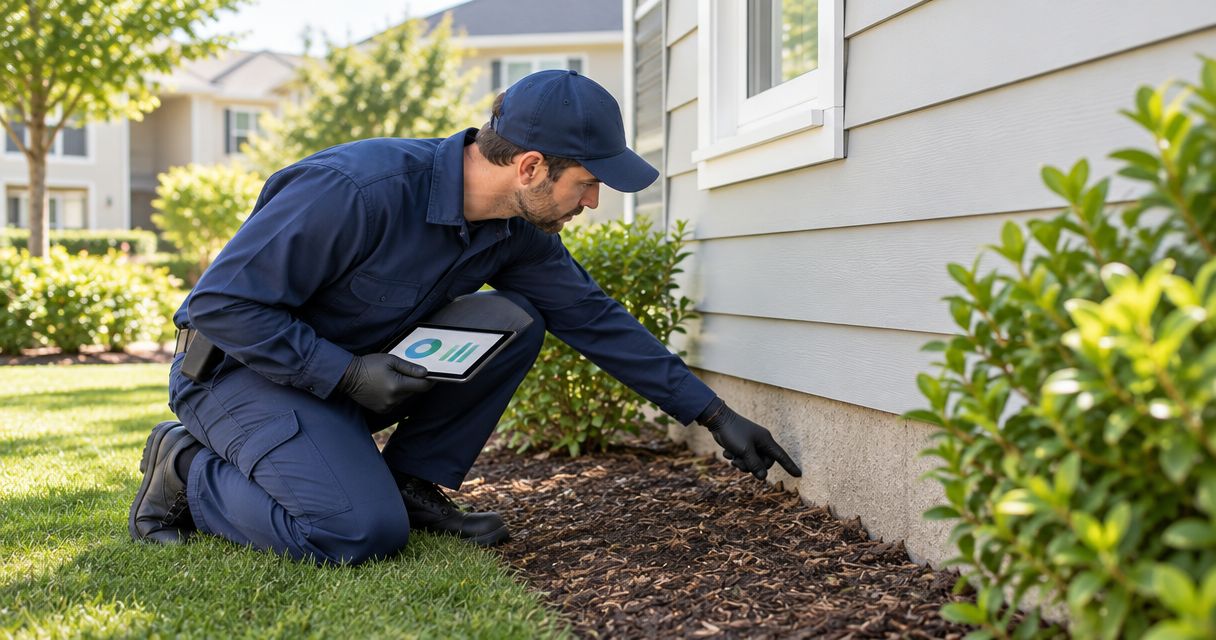
HOA pest control is coordinated inspection, prevention, and treatment with the aim of reducing pest activity across shared property and individual homes. This 2026 guide explains pest control for HOAs and homeowners associations, where access, maintenance duties, and resident communication matter as much as treatment.
- Pest control for HOAs and homeowners associations needs clear responsibility boundaries, shared reporting, and coordinated access.
- Exo-Pest provides residential and commercial pest control for local property owners seeking insect, rodent, and termite services.
- Match treatment to the identified pest; rodent exclusion addresses entry points rather than every source of activity.
- Exo-Pest’s 2-year rodent exclusion warranty covers only sealed entry points; other work and new damage are excluded.
Why pest control matters for homeowners associations
An HOA manages connected spaces, not just separate addresses. A resident reports ants inside a kitchen, while the maintenance team handles landscaping, irrigation, and shared waste areas. Those reports need a common record so the board can distinguish an isolated complaint from a shared maintenance issue.
Exo-Pest pest control is best for property owners seeking residential or commercial pest services in Santa Clara, San Mateo, and Alameda counties. You can request a free quote through Exo-Pest. Define the buildings, common areas, and pest concerns before requesting a service proposal.
The central challenge is coordination. A board cannot assume that an exterior service includes private interiors, tenant businesses, inaccessible crawl spaces, or structural repairs. Residents and commercial occupants also need separate access arrangements.
For your 2026 plan, make responsibility explicit before scheduling treatment. A clear scope lets homeowners understand what the association handles and gives managers a practical basis for comparing proposals. It also keeps a completed treatment from being mistaken for a completed repair.
How to organize an HOA pest control program
1. Map shared areas and responsibility boundaries
Start with a property map and the association’s governing documents. Mark individual homes, common buildings, shared walls, utility spaces, landscaping, and waste collection areas. Ask your association manager or qualified adviser to clarify disputed responsibilities rather than treating a service quote as a legal interpretation.
Include commercial spaces where the community has them. A clubhouse kitchen, management office, or tenant business has different access needs from a private residence. Record who can authorize work in each location.
Use the map as the foundation of your 2026 service scope. It should show what needs inspection without promising that every marked area falls under association responsibility.
- Label shared structures and privately controlled spaces.
- Identify the person authorized to approve each area.
- Mark locked gates, crawl-space doors, and utility rooms.
- Separate pest treatment from building maintenance duties.
2. Create a single reporting process
Use an existing email address, resident portal, or spreadsheet before buying another system. Ask residents and commercial occupants to submit the same basic information. A pest name alone is less useful than a location, observation date, photograph, and description of where activity occurred.
Keep personal information out of community-wide notices. Managers need enough detail to arrange access, but neighbors do not need another household’s schedule or contact details.
Review the previous 30 days of reports as an initial planning exercise. This is a recommended review window, not a required treatment interval. Look for repeated locations and unresolved access problems before requesting additional work.
- Record the location and date of each observation.
- Attach photographs when available without approaching wildlife.
- Note whether activity is indoors or outdoors.
- Track access permission separately from the complaint.
- Assign an owner to each unresolved report.
3. Match the service to the pest
Start with observation, photographs, and a safe visual check from accessible areas. Do not ask residents or staff to enter confined spaces, handle wildlife, or disturb suspected termite damage. Request professional identification when the evidence is unclear.
Exo-Pest pest control includes insect, rodent, wildlife, mosquito, and termite services. Request a free quote for the concerns present at your property rather than assuming one service covers every pest. Professional help provides a defined service scope; it does not remove the HOA’s responsibility to arrange permissions and maintenance.
Keep separate issues separate. Ant activity, rodent entry, and suspected termite damage require different questions. A proposal should identify the problem being addressed and the areas included.
- Describe evidence rather than guessing the species.
- Separate insect, rodent, wildlife, mosquito, and termite concerns.
- Ask which locations the proposed service includes.
- Request preparation and access instructions before scheduling.
4. Correct food, water, and access problems
Begin with work your existing maintenance team can safely assess: waste handling, accessible leaks, stored materials, and doors that do not close properly. Record defects instead of treating every maintenance problem as a pesticide issue.
For rodent concerns, distinguish control from exclusion. Rodent control addresses activity; exclusion addresses entry points. Read about what entry-point sealing involves for homes before approving a scope that crosses private and shared structures.
Do not authorize blanket sealing without an assessment. Ventilation, drainage, utilities, and animal activity need consideration. The written proposal should identify the openings included and any repairs outside the service scope.
- Waste storage: Check lids, spills, and collection arrangements.
- Water sources: Report leaks and irrigation problems.
- Entry points: Request assessment of gaps and damaged closures.
- Stored materials: Keep inspection routes accessible.

5. Coordinate access and occupant instructions
Create an access list before booking work. A locked utility room or an absent resident can leave part of the planned inspection unfinished. Record which spaces are confirmed, which require permission, and which remain outside the appointment.
Homeowners need instructions for their own rooms, pets, and belongings when relevant to the proposed work. Commercial occupants need instructions that account for staff, customers, deliveries, and operating hours. Do not substitute a general HOA notice for the provider’s actual preparation directions.
Use a 15-minute coordination meeting as a practical starting point for the manager, maintenance lead, and service contact. Extend it when the property needs more planning; the meeting length is not a service standard.
- Confirm keys, escorts, and gate arrangements.
- Identify homes or businesses requiring separate consent.
- Distribute the provider’s preparation instructions unchanged.
- Ask for treatment-specific access and reentry directions.
- Record inaccessible areas for a separate decision.
6. Compare written scopes before approving work
Build a simple comparison sheet from the proposals you receive. Compare the pest addressed, included locations, preparation, follow-up terms, exclusions, and documentation. A short description such as general pest control does not establish whether interiors, shared structures, or rodent entry-point sealing are included.
For your 2026 purchasing decision, separate recurring service from corrective work. A scheduled treatment visit and a structural exclusion project have different deliverables. Ask what completion means for each.
Read warranty language narrowly. Exo-Pest’s 2-year rodent exclusion warranty covers only the entry points Exo-Pest seals. Other work and new damage are excluded. It is not whole-property protection or an unconditional guarantee against rodent problems.
- Identify every included building or service area.
- List work that requires separate authorization.
- Ask how findings and completed work are documented.
- Distinguish follow-up service from warranty coverage.
- Keep the approved scope with the association’s records.
7. Review results and assign the next action
After service, compare the work record with the original report. Confirm where the provider gained access, what was completed, and what remains unresolved. Do not close a complaint simply because an appointment occurred.
Keep homeowner reports and commercial maintenance reports in the same tracking system, with appropriate privacy controls. That makes it easier to see whether the unresolved issue belongs with a resident, business occupant, maintenance contractor, or pest professional.
Set the next review around the provider’s recommendations and the property’s actual findings. Do not invent a universal service interval for every pest or building. Your 2026 records should show decisions and outstanding work, not just visit dates.
- Match completed work to the approved scope.
- Record areas that could not be inspected or treated.
- Assign repair tasks to a named responsible party.
- Compare new observations with earlier locations.
- Retain preparation instructions and service records.
Compare HOA pest control options
Choose an option by the problem it solves, not by its label. Maintenance, treatment, and exclusion can complement each other, but none automatically includes the others. Use this table to decide what belongs in a proposal.
| Option | Best for | Main advantage | Key limitation |
|---|---|---|---|
| HOA-led reporting and maintenance | Communities organizing prevention and complaints | Uses existing staff and records to identify unresolved tasks | Does not replace professional identification or treatment |
| Problem-specific professional service | A defined pest issue in an identified area | Connects the service scope to an observed problem | Does not automatically cover other pests or buildings |
| Recurring professional service | Associations seeking scheduled inspections or treatment | Creates planned opportunities to assess included areas | Unlisted locations and repairs remain outside the agreement |
| Rodent exclusion | Properties with identified rodent entry points | Addresses access through the openings included in the work | Does not cover every source of activity or future damage |
Ask Exo-Pest to quote the residential or commercial work you need. The available service categories support local property owners; HOA-specific reporting, scheduling, and approval requirements still need agreement before work begins.
Request a free pest control quote
Describe your shared areas, affected homes or businesses, and access requirements.
Common mistakes homeowners associations make
Treating every complaint as a common-area problem
A report inside a home does not establish who must authorize or fund the work. Check the governing documents and the location involved. Keep the responsibility decision separate from identifying the pest.
Treating commercial spaces like vacant common rooms
A tenant business or management office has occupants, equipment, and operating needs. Confirm the authorized contact and preparation requirements. An HOA-wide email does not establish permission to enter a separately controlled space.
Approving treatment without maintenance ownership
A service report can identify a damaged door or leak without including its repair. Assign that task to someone. Otherwise, the board receives repeated complaints while the underlying maintenance item stays open.
Reading a limited warranty as blanket protection
Sealed-entry-point coverage does not mean every opening, future alteration, or new damage is covered. Retain the work description and warranty terms together. Check both before assuming that later activity qualifies for covered work.
FAQ
Who is responsible for pest control in an HOA?
Responsibility depends on the association’s governing documents, the affected location, and the proposed work. Confirm who can authorize service before scheduling work in common areas, private homes, or commercial spaces.
What is the best pest control approach for homeowners associations?
The best approach combines a shared reporting process, property maintenance, and professional service matched to the identified pest. Use a written scope so residents and managers know which locations and tasks are included.
Can an HOA arrange treatment inside my home?
Interior access needs coordination with the person authorized to grant it and the association’s applicable procedures. Ask for the proposed scope, preparation instructions, and treatment-specific access directions before the appointment.
Does rodent exclusion replace rodent control?
Rodent exclusion addresses entry points; rodent control addresses activity. Ask the provider how existing activity and entry-point work will be handled rather than assuming either service includes the other.
What does Exo-Pest’s rodent exclusion warranty cover?
Exo-Pest’s 2-year rodent exclusion warranty covers only the entry points Exo-Pest seals. Other work and new damage are excluded; it is not whole-property protection or an unconditional guarantee.
How often should an HOA schedule pest control?
The service schedule should follow the identified pest, inspection findings, and agreed scope. Separate scheduled visits from new complaints and corrective repairs instead of applying one interval to every building.
Can local homeowners and commercial properties request a free quote?
Homeowners and commercial property customers in Santa Clara, San Mateo, and Alameda counties can request a free quote. Describe the affected areas, pest evidence, and access requirements so the proposed scope addresses the actual property.
One last thing
Record where work could not happen. An inaccessible crawl space or unapproved interior is an unfinished access task, not proof that the area has no pest activity. Put that distinction in your 2026 board records.
Before the next appointment, send the provider a property map, complaint locations, and an access list. Those documents help turn a broad request for pest control into an agreed scope with clear boundaries.
Related guides
- Pest control for property management companies
- Coordinating access for rodent exclusion at rental properties
- What Exo-Pest’s 2-year rodent exclusion warranty covers
Leave a Reply