
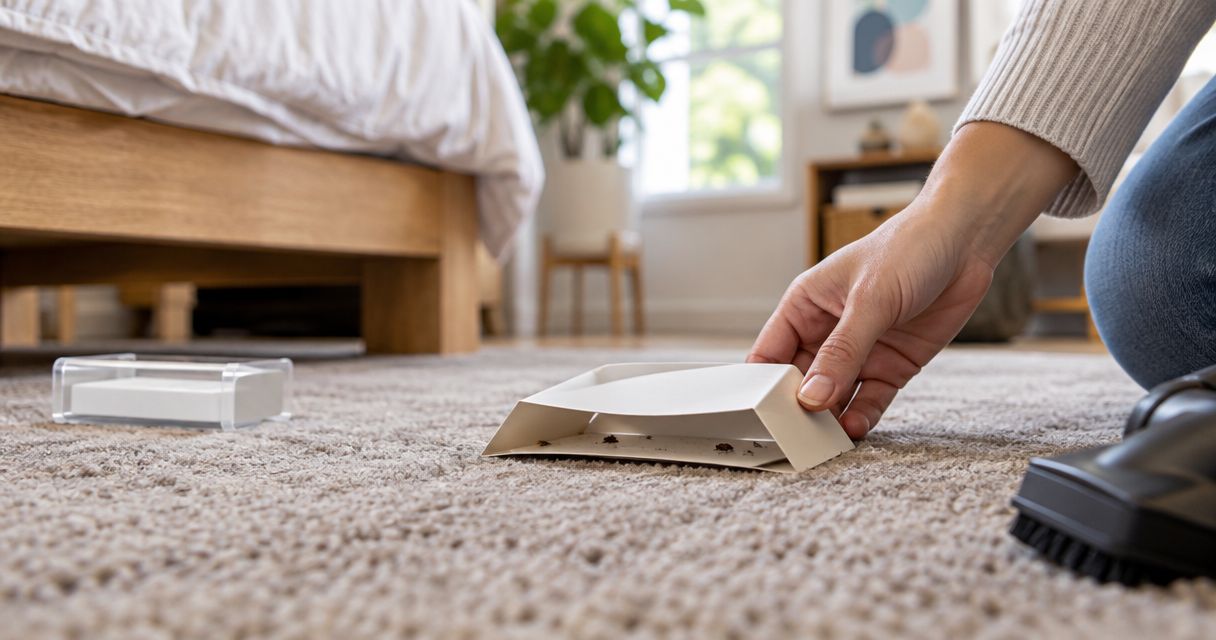
Best overall for basic monitoring: unbaited sticky monitors. Best for a confirmed species: species-matched pheromone traps. Best for adults gathering at windows: window-mounted sticky traps. The best carpet beetle traps San Jose homeowners choose should help locate activity—not replace finding and removing the source.
- Unbaited sticky monitors are the simplest starting point for carpet beetle monitoring, not a complete treatment.
- Species-matched pheromone traps require a confirmed identification and a label that names the target beetle.
- Window-mounted sticky traps monitor adults near windows; they do not address larvae feeding elsewhere.
- Exo Pest offers pest control for San Jose homeowners who need a property-specific service scope.
Why this matters
Carpet beetle larvae damage susceptible materials; the adults you notice at a window are a different life stage. Catching adults does not establish that larvae or their food sources are gone.
For your 2026 buying decision, separate monitoring from control. Monitoring helps you see where insects appear. Control addresses the insects and the materials supporting them. If you need help deciding what service fits, Exo Pest provides residential and commercial pest control in Santa Clara, San Mateo and Alameda counties.
Exo Pest is a pest-control service option for San Jose homeowners seeking a property-specific scope rather than another monitoring product. Share what you have observed before assuming that traps alone are the right next step.
What makes the best carpet beetle traps?
Choose a trap by what it can tell you, not by how broadly the packaging promises household pest control. These criteria drive the ranking:
- Correct target: A lure must name the relevant species. A moth lure is not automatically suitable for carpet beetles.
- Clear purpose: Look for monitoring instructions rather than assuming a trap eliminates an infestation.
- Useful placement: The trap should fit the location you need to monitor without exposing adhesive to routine household contact.
- Readable catches: You need to inspect the captured insect, distinguish it from debris and record its location.
- Manageable maintenance: Follow the label for inspection, replacement and disposal. Dust-covered adhesive provides poor monitoring.
- Honest limitations: No trap in this guide substitutes for inspecting susceptible materials and removing confirmed sources.
For 2026, the default recommendation is an uncomplicated monitor placed with a clear question in mind: Is activity occurring beside this closet, along this edge or at this window?
Carpet beetle traps at a glance
These are trap categories, not named product endorsements. Match the actual package label to your insect and intended placement before buying.
| Rank and option | Best for | Standout feature | Key limitation |
|---|---|---|---|
| 1. Unbaited sticky monitors | Mapping crawling insect activity near suspected sources | Captures insects that cross the adhesive without requiring a species-specific lure | A catch depends on contact; an empty trap does not prove absence |
| 2. Species-matched pheromone traps | Targeted adult monitoring after species identification | Uses a lure intended for the species named on the label | A mismatched lure is not a useful substitute; adult catches do not measure larval damage |
| 3. Window-mounted sticky traps | Monitoring adults appearing at windows | Places adhesive at the location where adults are being observed | Window catches do not identify the material supporting larvae |
1. Unbaited sticky monitors: best for mapping activity
Unbaited sticky monitors catch insects that physically cross their adhesive. They do not need a lure to work, making them a straightforward starting point when you want to document where crawling insects appear.
Use them beside a suspected activity area, following the placement instructions. Treat each catch as evidence to examine—not automatic confirmation of a carpet beetle infestation.
Unbaited sticky monitor pros:
- Does not depend on choosing a species-specific pheromone.
- Keeps captured insects available for closer examination.
- Supports location-by-location records when each monitor is labelled.
- Provides a simple way to monitor an accessible edge near suspected materials.
Unbaited sticky monitor cons:
- Captures only insects that contact the adhesive.
- Collects dust and non-target insects, which complicates interpretation.
- Does not remove larvae or food sources from stored materials.
Best for: You have seen a crawling insect, shed skins or suspected damage and want a record of nearby activity while investigating.
Keep exposed adhesive away from children, pets and household traffic. A folded cover can reduce accidental contact, but do not assume that a covered monitor is childproof or pet-safe.
Verdict: Buy for basic monitoring; do not treat catches as a complete control plan.
2. Species-matched pheromone traps: best after identification
A pheromone trap uses a lure intended to attract a particular target insect. Carpet beetles include different species, so the words beetle trap on a package are not enough to establish a match.
Choose this category only after identifying the insect and checking that the label names it. Pheromone traps are not interchangeable with clothes-moth traps, even when both products are marketed for closets or fabric pests.
Species-matched pheromone trap pros:
- Provides targeted monitoring when the insect and lure match.
- Gives you a defined target to record during follow-up checks.
- Helps organize adult-monitoring observations around labelled locations.
Species-matched pheromone trap cons:
- Requires a reliable identification before selection.
- Attractiveness depends on the target species and the lure's intended function.
- Adult catches do not establish how many larvae remain in materials.
Best for: You have a confirmed species identification and a product label explicitly listing that species.
For a 2026 purchase, read the current label rather than relying on a marketplace title or customer photograph. Check the target insect, placement instructions and replacement guidance; do not assume a lure remains suitable because an older package looked similar.
If the insect is still unidentified, save a clear photograph or contained specimen and resolve that question first. Buying a targeted lure before identifying the target reverses the useful order.
Verdict: Buy only after confirming the species and label match.
3. Window-mounted sticky traps: best for visible adult activity
Adult carpet beetles are often noticed near windows. A window-mounted sticky trap places a capture surface where you are already seeing insects, making it useful for documenting that specific activity.
A window catch answers a narrow question: adults are reaching that window. It does not show whether they developed indoors or identify a larval feeding site.
Window-mounted sticky trap pros:
- Matches a clearly observed location rather than a guessed source.
- Preserves captured adults for identification.
- Makes repeated observations at the same window easier to document.
Window-mounted sticky trap cons:
- Does not address larvae hidden in susceptible materials.
- Captures other insects that reach the adhesive.
- Requires placement that avoids routine contact with people, pets and window coverings.
Best for: You repeatedly notice adult beetles on a particular sill or window and want to document them while checking nearby rooms.
Follow the product's instructions for the intended mounting surface. Keep a photograph of the insect before disposing of the trap, especially if identification remains uncertain.
Verdict: Buy for window-specific monitoring; skip it as a stand-alone infestation solution.
What to do alongside carpet beetle traps
The most useful 2026 plan connects trap observations to an inspection of materials. Adding more adhesive without investigating the source leaves the central question unanswered.
Monitor activity
Start with 3 locations to compare: the window where adults appear, the edge nearest suspected damage and the relevant storage area. These are observation points, not a prescribed trap quantity; place products only where their labels permit.
Record the location, date, insect appearance and condition of each monitor. Compare observations within the same location instead of treating catches from unrelated rooms as equivalent evidence.
Find sources
Inspect 1 room at a time, beginning where you have actual signs. Check susceptible animal-derived materials such as wool, feathers, fur and silk, along with accumulated lint, hair and dead insects in undisturbed areas.
Take 2 photos when you find something relevant: a close-up of the insect or damage and a wider view showing its location. Photographs support a useful service conversation without requiring you to move material through the home.
Look for larvae, shed larval skins and damage together. Holes alone do not identify the pest, and a single adult does not reveal the extent of activity.
Remove sources
Once you identify affected material, separate it from unaffected belongings before moving it. Vacuum accessible lint and debris, including edges and storage areas, and handle the collected contents promptly so they do not remain loose indoors.
Follow care instructions for affected textiles. Ask a qualified cleaner about delicate items rather than improvising heat or chemical treatment that could damage them.
Monitoring, source inspection and source removal serve different purposes. Keep those tasks separate in your notes so a quieter trap does not become the only evidence used to judge progress.

When a service assessment is the better next step
Ask about professional help when activity continues after cleaning, affected materials are difficult to inspect or you cannot identify the insect. Inaccessible spaces and valuable textiles also deserve a defined scope before anyone starts work.
For a rental home or apartment, notify the property manager about observed signs and ask who coordinates access and service. For business premises, identify the affected room, materials and access constraints when requesting a quote.
Exo Pest provides pest-control services for homes and businesses. Describe what you are seeing and ask what identification, inspection or treatment work is included in the proposed scope. Do not assume a particular treatment method is part of the service before that discussion.
A free quote does not imply a free inspection, report or treatment. Ask what the quote covers and which activities require separate authorization.
How these trap categories were ranked
This 2026 ranking prioritizes a clear monitoring purpose, target suitability, readable catches and manageable placement. Unbaited monitors come first because they support basic observation without requiring a lure match; species-specific traps become useful after identification, and window traps serve a narrower location-based need.
The ranking does not claim comparative capture rates or treatment results. The right trap is the one that answers your next inspection question—not the one that promises to replace inspection.
Which carpet beetle trap should you choose?
Choose an unbaited sticky monitor when your immediate task is mapping crawling activity. Choose a species-matched pheromone trap only when identification and label agree. Choose a window-mounted sticky trap when adults repeatedly appear at a window.
If you already have damaged materials, prioritize investigating those materials over adding more traps. A monitoring purchase should support the source search, not delay it.
FAQ
What’s the best carpet beetle trap for a San Jose home?
An unbaited sticky monitor is the simplest starting point for basic crawling-insect monitoring. Choose a species-matched pheromone trap only after identification, or a window-mounted trap to document adults appearing at a window. None replaces finding and removing larval food sources.
Do carpet beetle traps get rid of an infestation?
Carpet beetle traps are monitoring tools, not a complete infestation solution. Capturing adults or occasional larvae does not remove insects and food sources within affected materials.
Will clothes-moth pheromone traps catch carpet beetles?
Do not rely on a clothes-moth pheromone lure to attract carpet beetles. The lure targets the insects named on its label; an incidental beetle caught on adhesive does not establish that the lure is suitable.
Where should I put carpet beetle sticky monitors?
Place monitors near observed activity and suspected sources where the product label permits. Keep adhesive away from children, pets and household traffic, and record each location so catches remain useful.
Does an empty trap mean the carpet beetles are gone?
No, an empty trap does not prove that carpet beetles are absent. Insects must encounter the monitor or respond to its intended lure, so also inspect affected materials and check for fresh signs.
Are carpet beetle larvae or adults responsible for fabric damage?
Carpet beetle larvae are responsible for damage to susceptible materials. Adults seen at windows are a different life stage, so adult catches alone do not measure the condition of stored textiles.
How do I request carpet beetle help from Exo Pest in 2026?
Share the insect’s appearance, where you found it and any material damage, then request a property-specific quote. Ask which identification, inspection and treatment activities are included; a free quote does not imply a free inspection, report or treatment.
One last thing
A trap full of adults and an empty trap can both leave the larval source unresolved. Before replacing a monitor, ask whether its location taught you anything about the affected material.
For help with the next step, request a quote and describe the signs, rooms and materials involved. Review the proposed scope before authorizing service.
Leave a Reply