
Retail store rodent exclusion is the inspection and sealing of building entry points to keep rodents out of stockrooms, sales floors, and stored merchandise. Retail stores need an approach that accounts for delivery doors, customer traffic, shared walls, and stock that moves throughout the day.
- Rodent exclusion for retail stores requires entry-point sealing, stockroom checks, and consistent delivery-door controls.
- Exo-Pest is a local service option for retail property owners seeking rodent exclusion in Santa Clara County.
- Trapping addresses rodents already inside; exclusion addresses the openings they use.
- Assign responsibility for shared doors, utility openings, and repair approvals before work begins.
Why rodent exclusion matters for retail stores
A retail store cannot treat every entrance as a permanently closed boundary. Customers enter, deliveries arrive, and employees move merchandise between receiving areas and shelves. A repaired wall opening does not resolve an exterior door left open during unloading.
Stockrooms also make inspection difficult. Cartons, shelving, and stored displays can hide the wall edges you need to check. The goal is to close building openings while keeping daily store operations from creating another route inside.
Exo-Pest is best for retail property owners seeking local rodent exclusion services rather than supplies alone. The company provides residential and commercial pest control services in Santa Clara, San Mateo, and Alameda counties. Professional service addresses building entry points; store staff still need to manage receiving practices, storage, and reporting.
For your 2026 maintenance plan, treat exclusion as a defined repair scope with an operating checklist—not as a substitute for checking doors or responding to fresh activity.
How to plan rodent exclusion for your store
Map the stockroom and exterior access points
Start with a manual walkthrough and a simple floor sketch. Mark the customer entrance, receiving door, stockroom perimeter, utility penetrations, and any route into a shared service corridor. Inspect only places you can reach safely; leave inaccessible voids and elevated areas for a qualified professional.
Separate observations from assumptions. A damaged carton is a reason to investigate, not proof that a particular wall opening is the source. Record what you see, where you see it, and whether the condition changes after deliveries or closing.
Use 3 inspection zones: the exterior boundary, the receiving area, and the stockroom perimeter. This gives your team a repeatable route instead of an unstructured search. Keep the map with your 2026 store maintenance records so replacement staff can follow it.
- Mark exterior doors and adjoining storage areas.
- Photograph visible gaps without disturbing suspected contamination.
- Record droppings, gnaw marks, and damaged packaging separately.
- Identify blocked inspection areas behind fixtures or stock.
- Note shared spaces that require landlord access.
Check entry doors in their closed position
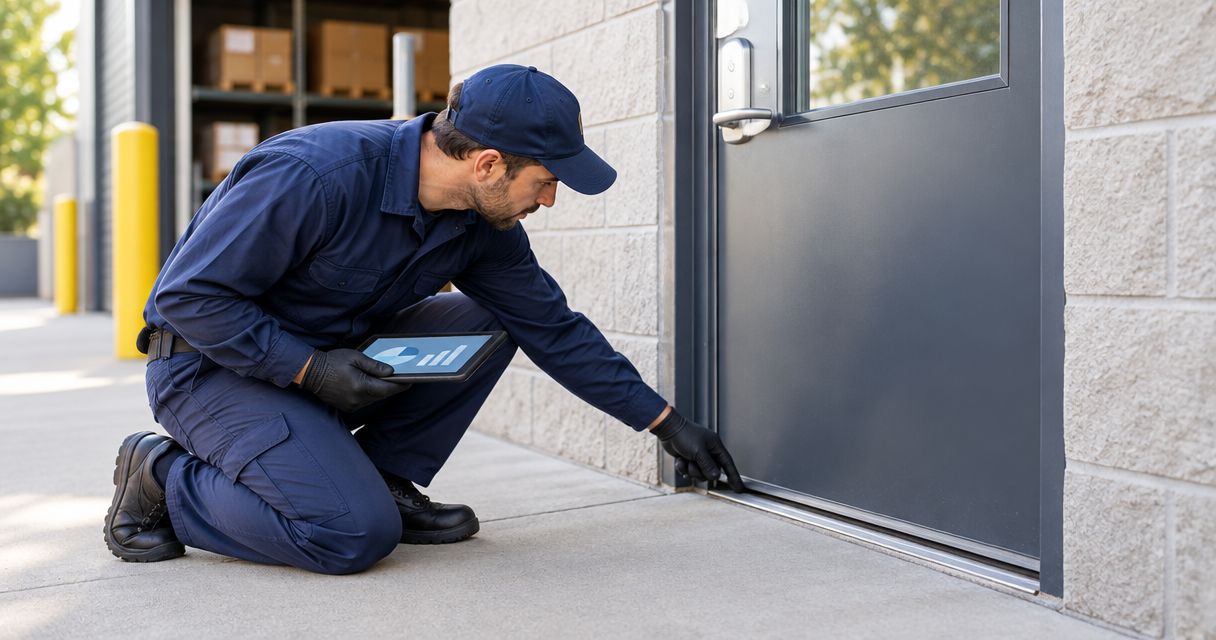
Check each exterior door after it closes normally. Look at the bottom edge, corners, threshold, and meeting edges of paired doors. A door that appears sound while held shut can still leave a gap when its closer releases or the threshold is damaged.
Door hardware needs to support both pest prevention and safe access. Do not improvise a barrier that prevents a door from opening, latching, or serving its intended emergency function. Ask the responsible contractor to address alignment and hardware problems rather than covering them with an unsuitable patch.
Begin with staff observations. Where the condition needs repair, Exo-Pest rodent exclusion provides a professional service option for assessing entry points; confirm the proposed work and any separate door-repair responsibilities in the quote.
- Inspect the bottom corners with the door fully closed.
- Check whether paired doors meet correctly.
- Record damaged sweeps, thresholds, and surrounding trim.
- Confirm doors close without merchandise obstructing them.
- Refer access and fire-door questions to the responsible professional.
Control the delivery-door opening
Write down how deliveries actually enter your store. Identify who opens the receiving door, who supervises unloading, and who confirms the door is closed afterward. A procedure that depends on an unnamed employee is easy to miss during a busy shift.
For your 2026 receiving checklist, include 2 door checks per delivery: one before unloading and one immediately afterward. These are recommended operating checks, not a replacement for inspecting the rest of the building. Avoid leaving the exterior door open while employees unpack or organize stock indoors.
Stores with larger receiving spaces can also use the principles in this guide to rodent exclusion for warehouses and loading areas. The shared issue is the connection between delivery activity and an open building boundary.
- Name the employee responsible for closing the receiving door.
- Clear the unloading route before opening the door.
- Keep staged cartons away from the closing path.
- Check incoming packaging for visible damage or pest evidence.
- Report a door that will not close instead of propping it open.
Expose the stockroom perimeter
Start by making the wall edges visible. Move loose cartons and unused displays where staff can inspect behind them without climbing or shifting unstable stacks. Keep access to electrical equipment, exits, and other required clearances intact.
Stockroom organization supports inspection; it does not seal a building. The useful distinction is between removing hiding places and repairing access points. Both belong in the plan, but neither should be presented as a substitute for the other.
If you find suspected droppings or nesting material, stop routine sweeping or vacuuming in that area. Follow current public-health guidance for rodent cleanup, and keep employees from treating contaminated packaging as ordinary stock. Separate the cleanup decision from the building-repair decision so neither task gets overlooked.
- Keep wall edges accessible for visual checks.
- Remove unused cartons and obsolete display materials.
- Store employee food and edible merchandise in appropriate closed containers.
- Isolate visibly affected merchandise from saleable stock.
- Record inaccessible spaces for professional inspection.
Coordinate trapping and sealing
Do not assume sealing alone resolves rodents already inside. Trapping and exclusion serve different purposes: trapping addresses existing indoor activity, while exclusion repairs access routes. The sequence needs to reflect what the inspection finds.
Start with a written record of sightings and affected areas. Ask the service provider how the proposed work addresses both existing activity and entry points. Avoid closing an uncertain opening without considering whether animals are inside the connected space or whether the opening serves ventilation or drainage.
Exo-Pest rodent exclusion is a service option for property owners who want professional assessment and entry-point work. Ask for a written scope that distinguishes sealing, rodent control, cleanup, and repairs handled by someone else. Do not assume every task is included under a general pest control description.
- Share the location and timing of recent sightings.
- Ask how existing indoor activity will be addressed.
- Identify openings that need further investigation before sealing.
- Confirm which repairs are included in the exclusion scope.
- Ask how completed work and remaining concerns will be documented.

Assign responsibility for shared building openings
A retail tenant does not necessarily control every opening connected to the store. Utility rooms, neighboring units, shared refuse areas, and service corridors can involve the landlord or another business. Record those boundaries before asking a contractor to complete repairs.
Assign 1 named owner to each unresolved item in your 2026 action list. The owner can be a store manager, landlord contact, or maintenance contractor. The point is accountability: every gap needs someone responsible for access, approval, or repair.
Do not confuse a sealed shopfront with a fully addressed building. Ask which areas were inspected and which remained inaccessible. If the source of activity is uncertain, keep that uncertainty in the work record rather than marking the whole issue complete.
- Confirm who authorizes changes to exterior doors and walls.
- Request access to relevant shared service spaces.
- Identify neighboring units connected by visible utility routes.
- Separate tenant maintenance from landlord-controlled repairs.
- Track unresolved openings until the responsible party responds.
Verify the work and keep checking
Walk through the completed scope with the service provider. Match the repairs to the inspection record and ask what remains outside the work. Keep photographs and written descriptions so future maintenance does not accidentally undo a sealed entry point.
Exo-Pest's 2-year rodent exclusion warranty covers only the entry points Exo-Pest seals. Other work and new damage are excluded. It is not whole-property protection, coverage for all rodent problems, or an unconditional guarantee.
Keep your 2026 follow-up record focused on observations: fresh damage, new sightings, door defects, and alterations around utilities. A completed exclusion job does not remove the need to report changed conditions. New cabling, replacement doors, or later damage deserve another look.
- Compare completed repairs with the agreed scope.
- Retain the written warranty and repair record.
- Report fresh activity with its location and date.
- Recheck areas after building alterations or door replacement.
- Assign an employee to keep the inspection record current.
Compare your retail rodent-control options
Choose the option that matches the task. Staff checks help identify changes, door repairs address door defects, and exclusion addresses building access points. A store with indoor activity also needs a plan for the rodents already present.
No single row below replaces every other row. Use the comparison to define responsibilities before approving work, especially when the tenant, landlord, and service contractor each control a different part of the solution.
| Option | Best for | Main benefit | Key limitation |
|---|---|---|---|
| Staff walkthrough and receiving checklist | Stores establishing a repeatable daily process | Records visible changes and door-use problems | Does not repair openings or resolve concealed activity |
| Door repair by the responsible contractor | Stores with damaged thresholds, alignment, or closing hardware | Addresses a defined door defect | Does not inspect or seal unrelated building openings |
| Professional rodent exclusion | Stores with suspected or confirmed building entry points | Connects inspection findings with a sealing scope | Requires access and does not replace ongoing store procedures |
| Trapping | Stores with rodents already inside | Addresses existing indoor activity | Does not close the routes used to enter |
Request a free quote for your store and describe the stockroom, receiving doors, and any shared access areas. Ask what the proposed service includes before approving the work.
Request a retail exclusion quote
Describe your stockroom, entry doors, and shared access areas when requesting a free quote.
Common mistakes retail stores make
Sealing gaps but ignoring delivery habits
A repaired perimeter cannot keep rodents out while a receiving door remains open. Put door closure into the delivery handoff, and give a specific employee responsibility for the final check.
Treating stockroom tidiness as exclusion
An orderly stockroom makes evidence easier to spot. It does not repair a threshold, wall opening, or utility penetration. Track housekeeping and building repairs as separate tasks so progress on one does not hide unfinished work on the other.
Stopping at the tenant boundary
A store inspection can leave questions unanswered when connected spaces remain inaccessible. Involve the landlord when the concern extends into a shared corridor, service room, or adjoining building area. Record access restrictions instead of assuming those areas are clear.
Assuming a warranty covers every future rodent issue
Read the covered work before relying on a warranty. Entry-point coverage is not the same as protection against every new opening, later damage, or rodent sighting. Keep the repair record available when reporting a concern.
FAQ
What is rodent exclusion for retail stores?
Rodent exclusion for retail stores is the inspection and sealing of building openings that rodents can use to enter. It should account for stockrooms, exterior doors, receiving areas, and relevant shared spaces.
Is sealing the stockroom enough to keep rodents out?
Sealing the stockroom alone does not address every route into a retail store. Exterior doors, utility openings, adjoining spaces, and delivery practices also need attention.
Should a retail store trap rodents before sealing openings?
A retail store needs a coordinated plan for existing rodents and entry-point repairs. Ask the service provider to explain the sequence based on the inspection rather than assuming sealing alone resolves indoor activity.
Can store employees handle rodent exclusion themselves?
Store employees can record visible gaps, check doors, and improve receiving and storage practices. Inaccessible areas, uncertain openings, contaminated material, and building repairs require the appropriate professional assessment.
Who handles rodent entry points in a leased retail space?
Responsibility depends on the lease and the location of the opening. Identify who controls exterior walls, door repairs, utilities, and shared rooms before authorizing work.
What does Exo-Pest’s rodent exclusion warranty cover?
Exo-Pest’s 2-year rodent exclusion warranty covers only the entry points Exo-Pest seals. Other work and new damage are excluded; it is not whole-property protection or an unconditional guarantee.
How do I request a free quote for a retail store?
Request a free quote and describe the store location, recent rodent evidence, stockroom layout, and receiving doors. Include any landlord access restrictions or shared spaces that affect inspection and repairs.
One last thing
Check the receiving door after the next delivery—not just before opening the store. That moment tests whether your exclusion plan works during normal business, when cartons, staff, and door hardware all interact. A sealing scope and a reliable closing procedure belong together.
Related guides
- Rodent exclusion for offices: checking shared access points
- Rodent exclusion for restaurants: doors, deliveries, and storage
- Rodent exclusion for rental properties: coordinating access
Leave a Reply