
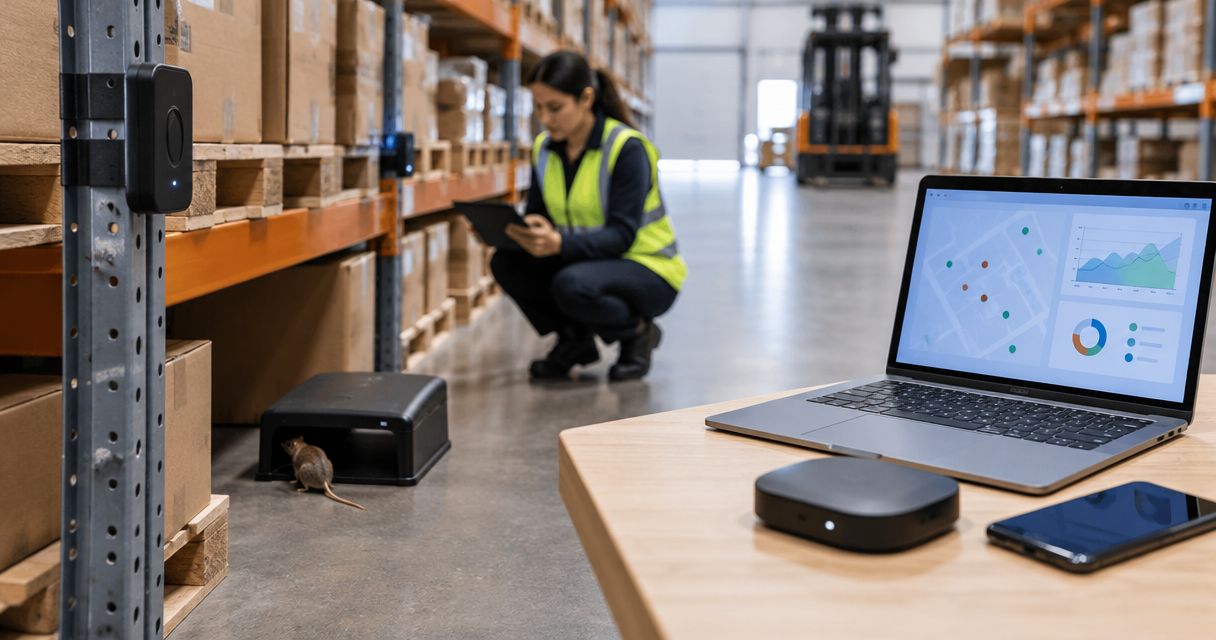
Best overall: enclosed, non-toxic monitoring stations. Best for remote notification: connected rodent sensors. Best for investigating travel routes: motion-triggered cameras. This 2026 guide compares the best rodent monitoring devices San Jose warehouses can use by detection task, inspection needs, and limitations—not by unsupported product rankings.
- The best rodent monitoring devices San Jose warehouses need start with enclosed stations and a documented inspection route.
- Connected sensors suit remote notification; cameras help investigate routes but do not replace physical inspections.
- Exo Pest is best for San Jose warehouse decision-makers seeking property-specific rodent-control and exclusion services.
- Monitoring records activity. Control addresses rodents; exclusion seals identified entry points.
Why this matters
A warehouse monitoring device answers a specific question: did something happen at this location? It does not establish that the whole building is clear, identify every entry point, or resolve an infestation by itself.
For your 2026 plan, separate detection from the response it triggers. Exo Pest provides commercial pest control and rodent exclusion in Santa Clara, San Mateo, and Alameda counties; the San Jose rodent-control guide explains the broader service context.
Choose the device around the evidence you need and the person responsible for reviewing it. An unread dashboard and an unchecked station leave the same operational gap: no documented response.
What makes the best warehouse rodent monitoring devices?
Use these criteria before choosing equipment. A feature only helps when it fits your building and inspection process.
- Detection purpose: Decide whether you need evidence of feeding, a trap-status signal, an activity alert, or footage of a suspected route.
- Placement suitability: Check the manufacturer's instructions against dust, moisture, cleaning practices, vehicle traffic, and the proposed location.
- Inspectability: Choose equipment staff or the service provider can safely access without moving heavy stock or entering restricted spaces.
- Record quality: Require a way to connect each observation to a device location, inspection date, and follow-up action.
- Response ownership: Name who checks physical devices, reviews alerts, and escalates findings.
- Operational limits: Confirm maintenance, power, connectivity, and any site-specific restrictions before selecting electronic equipment.
Do not treat a monitoring label as proof that a device suits food storage, outdoor exposure, or a particular pest. Verify the intended use for the actual equipment.
Warehouse rodent monitors at a glance
These are device categories, not endorsements of named products. Their order reflects a practical starting point for a warehouse monitoring plan in 2026; the right combination depends on the property.
| Rank and option | Best for | Standout function | Key limitation |
|---|---|---|---|
| 1. Enclosed non-toxic monitoring stations | Routine inspection routes | Provides a fixed location for checking physical evidence | Requires inspection; no automatic alert |
| 2. Connected rodent sensors | Remote activity notification | Sends an event signal when the selected system detects activity | Alerts need validation, working infrastructure, and an assigned responder |
| 3. Trap-status monitors | Monitoring an active trapping program | Indicates a compatible trap's status | Does not monitor areas beyond the trap location |
| 4. Motion-triggered cameras | Investigating suspected travel routes | Records visible activity within the camera's view | Coverage depends on framing, lighting, and triggers |
| 5. Tracking tunnels with non-toxic tracking media | Investigating suspected runways | Records footprints through a defined passage | Evidence needs interpretation and protection from disturbance |
1. Enclosed monitoring stations: best for routine inspection routes
Enclosed monitoring stations create fixed checkpoints where a technician can inspect non-toxic monitoring material or other evidence. Specify a monitoring-only setup: an enclosure alone does not tell you whether its contents are non-toxic, trapping, or rodenticidal.
For a warehouse starting a documented inspection route, this is the clearest default. Each station needs an identifiable location and an accessible position that does not interfere with operations.
Enclosed monitoring station pros:
- Creates repeatable checkpoints for physical inspections.
- Supports location-based records without requiring network connectivity.
- Allows staff to distinguish monitoring-only equipment from other devices when clearly labeled.
Enclosed monitoring station cons:
- Provides no automatic notice between inspections.
- A clean station does not establish that nearby areas have no rodent activity.
Best for: Warehouses that can maintain a physical inspection route and want a straightforward monitoring baseline.
Check the station's condition and surroundings, not just its contents. Record displaced equipment, blocked access, nearby droppings, and changes to stored goods. Do not interpret an untouched monitor as permission to ignore other evidence.
Verdict: Buy for a documented baseline, with placement and inspection responsibilities agreed first.
2. Connected rodent sensors: best for remote notification
Connected rodent sensors report events through a compatible receiver, application, or monitoring platform. Detection methods and reporting functions differ, so confirm exactly what generates an alert before choosing a system.
Remote notification is useful when someone will review it and arrange follow-up. It is not a substitute for checking the location or assessing the building.
Connected rodent sensor pros:
- Supports notification between scheduled physical checks.
- Can associate detected events with identified device locations.
- Helps direct follow-up toward the location that generated a signal.
Connected rodent sensor cons:
- Depends on the selected system's power, communications, and reporting arrangements.
- An event signal does not necessarily identify the species, entry point, or extent of activity.
Best for: Facilities with an assigned alert reviewer and a clear process for investigating reported activity.
Before including connected monitoring in a 2026 specification, ask for a demonstration of an activity alert and a device-fault notification. Confirm who receives each message, who maintains the equipment, and how an unresolved alert stays visible.
Verdict: Buy when notification ownership and system maintenance are defined; otherwise, wait.
3. Trap-status monitors: best for an active trapping program
Trap-status monitors indicate the condition of compatible traps, such as whether a mechanism has activated. They support a trapping program; they are not a standalone survey of the warehouse.
Keep the terms separate in your records. A triggered trap is a reported device condition, while a confirmed capture requires verification.
Trap-status monitor pros:
- Directs attention to traps reporting a changed condition.
- Links a status report to an identified trap location.
- Adds a notification function to compatible trapping equipment.
Trap-status monitor cons:
- Compatibility must be checked against the actual trap and monitoring system.
- A status signal does not remove the need to inspect and service the trap.
Best for: Warehouses with a defined trapping scope and someone responsible for servicing activated equipment.
Ask how the system records resets, faults, and completed service. If the record only shows that a notification was sent, it does not show that the issue was resolved.
Verdict: Buy as an addition to an established trapping program, not as your only monitoring method.
4. Motion-triggered cameras: best for investigating travel routes
Motion-triggered cameras can record activity within a selected field of view. They are useful for investigating a suspected route near a wall, doorway, or storage area when the scene can be framed clearly.
A camera records what enters its view under its operating conditions. It cannot establish that rodents are absent from concealed spaces or other parts of the building.
Motion-triggered camera pros:
- Provides visual evidence for reviewing suspected movement.
- Helps distinguish visible behavior from assumptions based on sound alone.
- Supports focused investigation without placing monitoring media on the floor.
Motion-triggered camera cons:
- Poor framing, obstructions, or unsuitable settings can leave activity unrecorded.
- Requires footage review and attention to workplace privacy and site policies.
Best for: A targeted investigation where the question is where visible activity occurs, rather than whether every warehouse zone is clear.
Keep the view focused on the relevant location. Review camera placement after stock moves, since a pallet or carton can obstruct a previously useful view.
Verdict: Buy for targeted investigation; skip as the sole warehouse monitoring system.
5. Tracking tunnels: best for investigating suspected runways
Tracking tunnels use a sheltered passage and suitable non-toxic tracking media to record footprints. They provide physical evidence that an animal passed through that specific location.
Use purpose-made equipment according to its instructions. Do not scatter improvised powders around stored goods or working areas.
Tracking tunnel pros:
- Records passage without requiring an electronic connection.
- Supports focused checks along suspected travel routes.
- Produces physical evidence that can be photographed and logged.
Tracking tunnel cons:
- Footprints require interpretation and do not establish the total number of animals present.
- Dust, moisture, disturbance, and poor placement can reduce the usefulness of the record.
Best for: A focused investigation where tracking media can be contained and protected from warehouse operations.
Check whether the device fits the site's housekeeping and product-handling requirements before placement. Keep the tunnel identifiable so staff do not mistake it for debris.
Verdict: Buy for a defined investigation; skip where the tracking surface cannot remain protected.
How the options are ranked
The ranking prioritizes inspectability, a clear detection purpose, and a workable response. Enclosed stations lead as a physical baseline; connected sensors, trap-status monitors, cameras, and tracking tunnels address more specific questions.
This is a category-level selection guide, not a product test or a comparison of manufacturers. No device earns a recommendation merely by adding wireless reporting or a dashboard.
Turn monitoring into a documented response
For your 2026 warehouse plan, assign 1 named owner to the monitoring record and maintain 1 current device map. These are recommended administrative controls, not claims about a regulatory minimum.
Use the following sequence so observations lead to action:
- Map locations: Give each device a unique identifier and record its position, purpose, and access needs.
- Record observations: Log the date, device condition, physical evidence, and relevant changes nearby.
- Assign follow-up: Name the person responsible for investigating an alert or finding.
- Verify action: Record what was checked, what work occurred, and whether further investigation is needed.

Review placement whenever stock layouts, door use, or access conditions change. Avoid carrying an old device map into a changed building without checking it against the floor.
If you find suspected droppings, keep people away from the material and follow public-health cleanup guidance. Do not dry sweep or vacuum rodent waste; ask for appropriate cleanup instructions rather than disturbing it during a routine device check.
Monitoring, control, and exclusion are different jobs
Monitoring records evidence. Control addresses current rodent activity. Exclusion closes identified entry points. Buying detection equipment does not complete the other work.
Exo Pest offers commercial pest control and rodent exclusion. Ask for a property-specific scope that distinguishes the monitoring task, proposed control work, and identified openings included in exclusion.
Properly sealing identified entry points supports long-term protection, but it is not a promise that rodents can never return. New damage, changed building conditions, and openings outside the agreed work remain separate concerns.
Do not assume crawlspace cleaning belongs in every warehouse proposal. Discuss access and cleaning work only where the property has a relevant space and the scope calls for it.
Which warehouse monitoring device should you choose?
Start with enclosed, non-toxic monitoring stations when you need a manageable physical inspection baseline. Add connected sensors for remote notification, trap-status monitors for a trapping program, or cameras and tracking tunnels for focused investigations.
For a 2026 equipment decision, write the response process before approving the device. If nobody owns the inspection or alert, choose a simpler arrangement that your team can maintain.
FAQ
What’s the best rodent monitoring device for a San Jose warehouse?
Enclosed, non-toxic monitoring stations are the default starting point for a warehouse with a documented physical inspection route. Add other devices when you need remote notification, trap-status reporting, or evidence of a suspected travel route.
Are connected rodent sensors better than ordinary monitoring stations?
Connected sensors are better suited to remote event notification, while ordinary stations support direct physical inspection. Choose based on who will review alerts, maintain equipment, and investigate findings.
Can a warehouse camera replace rodent monitoring stations?
A camera should not be the sole warehouse monitoring method. It records activity within its view, while obstructions, settings, and concealed spaces limit coverage.
Does a rodent monitoring station contain poison?
A monitoring station does not necessarily contain poison. Specify non-toxic monitoring contents and verify the actual setup, because similar enclosures can serve different purposes.
How often should warehouse rodent monitors be checked?
Set the inspection schedule around device instructions, site requirements, observed activity, and the agreed service scope. Arrange follow-up when a device reports activity or staff find new evidence rather than waiting automatically for the next routine check.
Does rodent monitoring stop rodents from entering a warehouse?
Rodent monitoring does not seal entry points. Exclusion addresses identified openings, while monitoring provides evidence that informs investigation and follow-up.
What should I send when requesting a warehouse rodent-control quote?
Send the property location, observed signs, affected areas, access restrictions, and any existing monitoring records. Exo Pest can discuss a property-specific scope; a free quote does not imply a free inspection, report, or treatment.
One last thing
A device can be working correctly and still answer the wrong question. Before choosing equipment, finish this sentence: “When this device reports activity, the responsible person will do this next.”
Share what you are seeing, where it occurs, and what monitoring is already in place. Request a property-specific quote and review the proposed control and exclusion scope before authorizing work.
Leave a Reply