
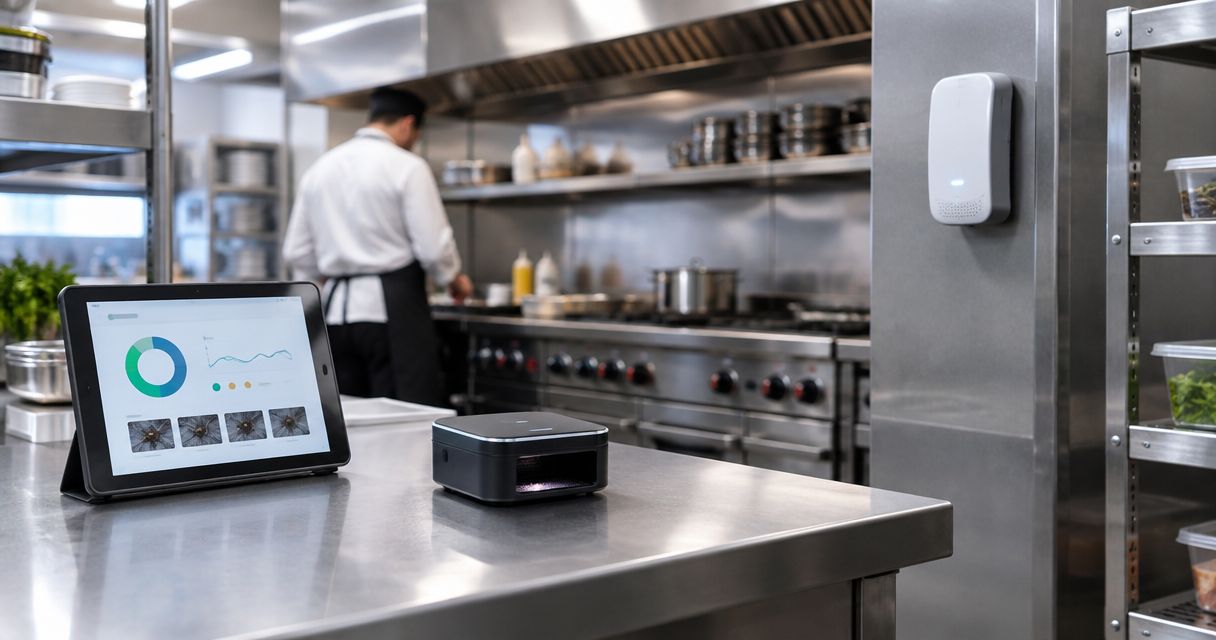
Best overall for crawling-insect checks: insect glue monitors. Best for rodent activity: enclosed mechanical monitoring traps. Best basic option: numbered glue monitors with a written inspection log. This 2026 guide compares the best pest monitoring devices commercial kitchens can use for distinct jobs—not a single device expected to detect every pest.
- The best pest monitoring devices commercial kitchens use match the target pest: start with insect glue monitors for crawling-insect checks.
- Enclosed mechanical monitoring traps address rodent activity; fly lights and pantry pheromone traps serve different insect-monitoring needs.
- Exo Pest provides commercial pest control; share observed signs and request a property-specific quote.
- Monitoring identifies activity. Control addresses current pests, while exclusion seals identified entry points.
Why this matters
A device without an assigned location, inspection record and response plan gives you incomplete information. An empty monitor does not establish that a kitchen is pest-free; placement, condition and the pest being monitored affect what it detects.
For San Jose and Palo Alto kitchen operators, Exo Pest provides commercial pest control within its Santa Clara, San Mateo and Alameda county service area. Share where you see activity before choosing equipment or requesting a property-specific scope.
The right monitor answers a specific question: what pest is active, where, and what needs attention next? Treat a capture as information to investigate, not proof that the underlying problem is resolved.
What makes the best commercial kitchen pest monitors
Use these criteria for your 2026 purchasing checklist:
- Target match: Choose equipment intended for crawling insects, flying insects, stored-product pests or rodents—not an unspecified pest problem.
- Food protection: Select a location and device design that prevent contamination of food, utensils and preparation surfaces.
- Readable evidence: Favor devices that let the responsible person identify captures and record their location.
- Service access: Staff must reach the device without moving it unpredictably or disrupting food handling.
- Environmental fit: Check suitability for moisture, cleaning practices, temperature and the proposed installation position.
- Response ownership: Assign someone to inspect, document and escalate findings. A notification does not replace a response.
Commercial kitchen pest monitors at a glance
These options serve different monitoring tasks. The order reflects a practical starting point for a 2026 kitchen monitoring plan, not a claim that every kitchen needs every device.
| Device type | Best for | Standout feature | Key limitation |
|---|---|---|---|
| Insect glue monitors | Crawling-insect checks | Retain insects for identification and location tracking | Moisture, debris and poor placement reduce usefulness |
| Enclosed mechanical monitoring traps | Rodent activity | Capture evidence inside a protective housing | Require appropriate placement, inspection and safe servicing |
| Glue-board insect light traps | Indoor flying-insect monitoring | Combine an insect-attracting light with a capture board | Need careful positioning away from exposed food |
| Stored-product pheromone traps | Suspected pantry moth activity | Use a target-specific lure | Do not detect every pantry pest or locate every source |
| Remote rodent monitoring sensors | Oversight across dispersed locations | Compatible systems send activity or device-status notifications | Depend on system compatibility, connectivity and follow-up |
1. Insect glue monitors: best for crawling-insect checks
Insect glue monitors retain insects that cross their adhesive surface. In a commercial kitchen, they help document crawling-insect activity around appropriate sheltered locations rather than relying only on sightings during service.
Use the capture for identification. A small insect on a board is not automatically a cockroach, and a catch near an appliance does not establish that the appliance is the source.
Insect glue monitor pros:
- Captures remain available for identification.
- Location labels connect findings to a specific area.
- Inspection records let you compare findings over time.
Insect glue monitor cons:
- Water, grease and debris interfere with the adhesive.
- An empty board does not rule out activity elsewhere.
Place monitors according to their instructions and the property's monitoring plan, away from food-contact surfaces. Do not scatter unlabelled boards throughout the kitchen; you lose the location history when staff move them during cleaning.
Best for: Routine crawling-insect checks near suitable sheltered areas, with consistent inspection and identification.
Verdict: Buy insect glue monitors as a basic monitoring tool, not as a substitute for cockroach control.
2. Enclosed mechanical monitoring traps: best for rodent activity
Enclosed mechanical monitoring traps use a mechanical capture device within a housing. They provide evidence of rodent activity while helping separate the mechanism from routine kitchen traffic.
An enclosure is not automatically tamper-resistant, and a monitoring trap is not the same as a rodenticide bait station. Confirm the actual device design and intended use before placing it.
Enclosed mechanical monitoring trap pros:
- A capture provides direct evidence of rodent activity.
- A housing helps protect the mechanism from incidental contact.
- Labelled locations support inspection and follow-up records.
Enclosed mechanical monitoring trap cons:
- Traps require inspection and safe handling of captures.
- Capturing rodents does not close entry points.
Keep servicing responsibilities clear. Staff should know whom to notify when a device is disturbed or a rodent is found, without improvising relocation or disposal procedures.
Control addresses current rodents. Exclusion addresses identified openings that let rodents enter; cleaning addresses affected areas as appropriate to the agreed scope. Those are separate tasks, even when they belong in the same property plan.
Best for: Documenting and responding to rodent activity in a professionally planned monitoring layout.
Verdict: Buy enclosed mechanical monitoring traps when rodent monitoring is needed, with placement and servicing agreed first.
3. Glue-board insect light traps: best for indoor flying insects
Glue-board insect light traps attract susceptible flying insects toward a light and retain them on an adhesive board. Captures provide material for identification and a record of activity at that location.
Choose a glue-board design rather than assuming every electric insect device works the same way. Food-area placement matters as much as the equipment itself.
Glue-board insect light trap pros:
- Retains captured insects for examination.
- Supports location-based flying-insect records.
- Replaceable boards preserve an inspectable capture surface.
Glue-board insect light trap cons:
- Does not resolve breeding material or entry routes.
- Unsuitable placement risks contaminating exposed food or attracting insects toward sensitive areas.
The FDA Food Code addresses installation of insect-control devices to prevent contamination of food and food-contact items. Review the manufacturer's instructions and applicable local requirements before installation; do not position equipment directly above exposed food or clean utensils.
Fly identification matters. A device catching flying insects near a doorway does not tell you whether the source is outside, in stored goods or elsewhere inside the property.
Best for: Indoor flying-insect monitoring where a suitable, food-protective installation location exists.
Verdict: Buy a glue-board insect light trap only after confirming its placement and maintenance plan.
4. Stored-product pheromone traps: best for pantry moth checks
Stored-product pheromone traps use lures intended for particular pests. For suspected pantry moth activity, a correctly matched trap helps document adult moth activity around dry-goods storage.
Read the target-pest information before choosing a lure. A trap intended for a particular moth is not a general detector for beetles, cockroaches or rodents.
Stored-product pheromone trap pros:
- Provides targeted monitoring for the pest named on the lure.
- Retains captures for identification and documentation.
- Helps direct attention toward affected storage areas.
Stored-product pheromone trap cons:
- Detects only pests responsive to the selected lure.
- Capturing adults does not remove infested ingredients or packaging.
Pair trap findings with an inspection of relevant stored materials. Record the trap location and the nearby stock involved, but do not assume the closest package is the source without checking it.
Keep the original lure information with your monitoring records. Without it, a later reviewer cannot reliably interpret what the device was intended to detect.
Best for: Targeted pantry moth monitoring after identification points toward a stored-product pest.
Verdict: Buy a matching pheromone trap after identifying the target; skip an unspecified pantry-pest lure.
5. Remote rodent sensors: best for dispersed monitoring locations
Remote rodent monitoring sensors support oversight by reporting activity or device status through a compatible system. Depending on the equipment, a notification can prompt someone to inspect a particular location.
Check what the selected system actually detects. Movement, a trap activation and a confirmed capture are different events, and the notification should not be treated as interchangeable evidence.
Remote rodent sensor pros:
- Identifies a reporting location when the system is configured correctly.
- Supports oversight across separated monitoring points.
- Creates notifications that an assigned person can follow up.
Remote rodent sensor cons:
- Requires compatible equipment and working communications.
- Does not identify entry points, remove captures or perform cleaning.
Before adopting a system, confirm who receives notifications, how missed communications are handled and who physically checks the location. A dashboard with no responsible responder adds equipment without completing the monitoring process.
Remote monitoring also leaves crawling-insect, flying-insect and stored-product monitoring needs unresolved unless separate suitable equipment addresses them.
Best for: Properties with dispersed rodent monitoring points and a defined notification-response process.
Verdict: Hold until compatibility, connectivity and response ownership are confirmed.
How these options are ranked
This 2026 ranking prioritizes target match, readable evidence, food protection and practical servicing. Insect glue monitors take the default position for crawling-insect checks because they retain specimens for identification; they do not outrank rodent equipment when rodents are the actual concern.
The comparison covers device categories, not tested commercial models. Choose the pest-monitoring job first, then evaluate equipment instructions and the proposed installation.
Put the devices into a usable monitoring plan
Use this sequence before adding equipment:
- Observe: Record what staff saw and the exact location. Photograph signs from a safe position without disturbing suspected contamination.
- Identify: Establish the target pest before selecting a specialized lure or interpreting captures.
- Map: Assign 1 station ID per device and keep that identifier tied to its location.
- Record: Include at least 3 fields per inspection: date, finding and action. Add condition or servicing details when relevant.
- Respond: Define who reviews evidence and arranges the appropriate next step.

For your 2026 plan, assign 2 roles: inspection owner and response owner. The same person can hold both roles, but neither responsibility should remain implicit.
Set inspection and replacement arrangements around device instructions, observed activity and the property's conditions. Do not extend an inspection interval simply because the previous check was empty.
Which pest monitoring devices should you choose?
Start with labelled insect glue monitors when your task is routine crawling-insect monitoring. Choose enclosed mechanical monitoring traps for rodents, glue-board light traps for suitable flying-insect monitoring locations, and target-specific pheromone traps for identified pantry pests.
Exo Pest is a commercial pest-control option for Bay Area property decision-makers seeking a property-specific service scope. Share the observed signs, affected rooms and existing device records so the quote request addresses the actual concern.
Do not make equipment purchases your only response to active pests. Monitoring documents evidence; control addresses current activity; exclusion seals identified entry points. None of those terms means the others have been completed.
FAQ
What’s the best pest monitoring device for a commercial kitchen?
Insect glue monitors are a practical starting point for crawling-insect checks, but no single device monitors every kitchen pest. Use equipment matched to rodents, flying insects or pantry pests when those are the concern.
Are insect glue monitors enough to control cockroaches?
No. Insect glue monitors capture evidence and help track locations, but they do not replace a control plan. Identify captures and investigate the conditions associated with activity.
Can I put an insect light trap above a food preparation counter?
Do not install an insect light trap where it risks contaminating exposed food or food-contact items. Follow the equipment instructions and applicable food-safety requirements when selecting its location.
Are rodent monitoring traps the same as bait stations?
No. A mechanical monitoring trap uses a capture mechanism, while a rodenticide bait station holds bait as part of a control program. Check what a particular enclosure contains rather than judging by its exterior.
How often should kitchen pest monitors be checked?
Set the inspection schedule using device instructions, observed activity and property conditions. Assign a responsible person and record findings consistently rather than relying on an occasional visual check.
Does an empty pest monitor mean the kitchen has no pests?
No. An empty monitor means that device recorded no capture during the inspection period. Placement, device condition and target-pest behavior limit what that result establishes.
Do remote rodent sensors replace on-site inspections?
No. Remote rodent sensors provide notifications or status information, but someone still needs to verify findings and perform the required response. Confirm what the selected system detects before relying on its alerts.
How do I request commercial pest control from Exo Pest?
Share the property location, observed signs, affected areas and existing monitoring records when requesting a property-specific quote. A free quote does not imply a free inspection, report or treatment.
One last thing
Do not erase the location history when you replace a monitor. Keep the station identifier attached to the recorded location, and document any intentional move; otherwise, a change in captures becomes harder to interpret.
For a 2026 monitoring plan tied to your property's conditions, request a property-specific quote. Describe what you are seeing and ask which monitoring, control or exclusion work belongs in the proposed scope.
Leave a Reply