
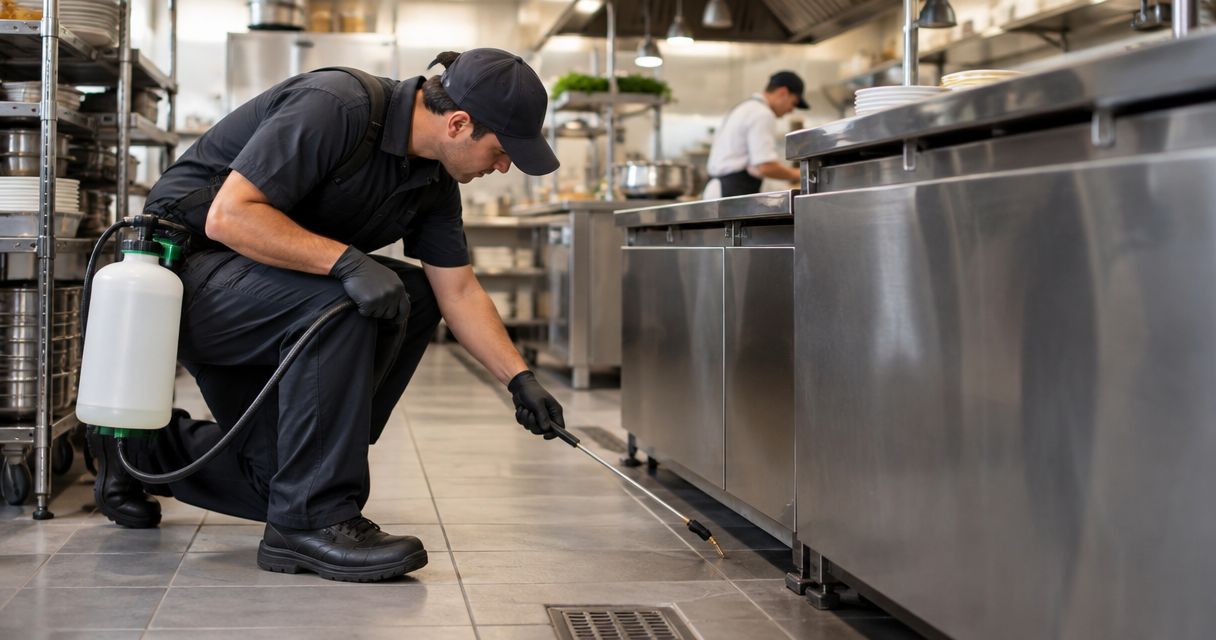
Restaurant pest control is the coordinated prevention, monitoring and management of pests with the aim of protecting food and keeping food-service spaces sanitary. Effective pest control for restaurants connects kitchen cleaning, delivery checks, building repairs and a property-specific service scope rather than treating every sighting as an isolated problem.
- Restaurant pest control works best when sanitation, monitoring, rodent control and exclusion have separate responsibilities.
- Exo Pest provides commercial pest control; restaurant decision-makers should request a property-specific scope before authorizing work.
- Keep pest observations specific: location, time, evidence and the action assigned.
- Protect food first, then address pest activity and the conditions allowing access.
Why pest control matters for restaurants
Restaurants combine food storage, preparation, waste handling and frequent deliveries within connected spaces. A clean dining room does not establish what is happening behind equipment, beside a receiving door or inside a shared service corridor.
Your 2026 pest-control plan needs to connect those areas. The practical objective is to detect activity, protect food and correct contributing conditions without leaving responsibility unclear between kitchen staff, management, the landlord and the service provider.
Exo Pest provides residential and commercial pest control, rodent exclusion and crawlspace cleaning in Santa Clara, San Mateo and Alameda counties. Exo Pest commercial pest control is best suited to Bay Area property decision-makers seeking a property-specific service scope. Confirm the proposed work for your restaurant rather than assuming a general service description includes every task.
Build your restaurant's pest-control plan
Record the signs before choosing a response
Start with a written log or shared spreadsheet. Record what staff actually observed, not a diagnosis based only on a noise or an unfamiliar mark. A photograph taken from a safe distance helps preserve details without requiring anyone to handle the evidence.
Create 1 shared log per restaurant so reports from the opening crew, closing crew and manager reach the same place. That is an operating recommendation, not a regulatory reporting requirement. Separate current observations from older entries so an unresolved repair does not disappear beneath new reports.
Make each entry useful to the person who must act. A description such as droppings beside the receiving door gives more direction than a general complaint about rodents.
- Record the date, time and exact location.
- Describe the sighting, sound, damage or other evidence.
- Note whether exposed food or food-contact surfaces were nearby.
- Attach a photograph when it is safe to take one.
- Assign an owner and record the next action.
Protect food and correct accessible conditions
Begin with tasks your staff can perform safely: close food containers, clear spills, remove unnecessary cardboard and report leaking fixtures. Check the less visible areas included in your cleaning procedures, not just the surfaces customers see.
If you find signs of contamination, keep affected food and equipment out of use while the manager follows applicable food-safety procedures. Do not sweep or vacuum rodent droppings; CDC guidance calls for wet disinfection and appropriate precautions. Cleaning contaminated areas is different from ordinary end-of-shift housekeeping.
When activity continues or the source is unclear, request a professional assessment of the next steps. Exo Pest commercial pest control is an option for a property-specific quote; confirm the proposed inspection, treatment and follow-up scope before approving work.
- Close ingredient containers after use.
- Remove food residue beneath accessible equipment.
- Keep waste containers closed and their surroundings clean.
- Report leaks and persistent damp areas.
- Restrict access to suspected contamination pending appropriate cleanup.
Separate rodent control from exclusion
Rodent control addresses current activity; rodent exclusion addresses identified entry points. Removing current rodents does not repair an opening, and closing an opening does not establish that activity inside has ended. Ask how the proposed work coordinates both needs.
Start by documenting visible gaps, damaged door components and openings around accessible utility penetrations. Do not climb, dismantle equipment or enter a crawlspace to complete the list. Leave inaccessible areas for appropriately qualified personnel.
For your 2026 scope, distinguish pest-service work from landlord repairs and contractor work. Shared walls, refuse enclosures and neighboring units require clear responsibility, particularly when your restaurant does not control the whole building. Properly sealing identified entry points supports long-term protection, not a promise that rodents can never return.
- List visible openings without assuming every opening is active.
- Identify which doors or penetrations belong to your premises.
- Ask who authorizes repairs to shared building areas.
- Request a written description of proposed exclusion work.
- Confirm how current activity and entry-point repairs will be coordinated.

Map monitoring around restaurant operations
Start with 1 location map per restaurant, using a simple floor plan or sketch. Mark receiving, dry storage, food preparation, dishwashing, waste handling and staff-reported activity. A map makes observations comparable even when different people report them.
Monitoring identifies activity; it does not remove food sources or repair access points. Device selection and placement also need to account for food handling, cleaning access and the people working nearby. Do not move a service provider's devices without discussing the change.
When reviewing pest monitoring devices for commercial kitchens, focus on what each observation will trigger. A device that nobody checks or understands creates a recordkeeping gap rather than a working response plan.
- Mark observation locations consistently on the map.
- Keep monitoring locations accessible for agreed checks.
- Record changes in activity rather than isolated counts alone.
- Note equipment moves that affect access or visibility.
- Confirm who checks devices and who receives the findings.
Assign responsibilities across shifts and contractors
A written task list is the simplest starting point. Assign 1 named owner per corrective action, even when several people help complete it. The owner confirms completion; responsibility does not end when someone forwards a photograph.
For a 2026 restaurant operating plan, connect pest reporting to existing shift handovers instead of creating a separate process staff forget to use. Include the person responsible for cleaning, the manager authorized to approve service and the contact who can arrange building repairs.
A provider's visit cannot replace daily staff observations. Equally, staff should not be expected to diagnose hidden activity or select treatments outside their responsibilities. Define the handoff between routine housekeeping and professional work before a problem reaches a busy service period.
- Name the manager who reviews new observations.
- Assign cleaning corrections to the appropriate shift.
- Route structural repairs to the landlord or authorized contractor.
- Give the provider updated access and operating information.
- Close each action only after its completion is verified.
Review treatment choices around food handling
Start by identifying the pest and the affected area rather than choosing a product from a general pest claim. Ask what nonchemical corrections belong in the plan, then review any proposed treatment against the product label and the restaurant's operating conditions.
Questions about using rat repellent in kitchens belong within that food-safety review: a repellent claim does not establish permission to apply a product around exposed food or food-contact surfaces. Follow the specific label's permitted sites, restrictions and directions; do not substitute a household-use assumption for that review.
Ask the service provider to explain preparation and return-to-use instructions before work starts. Your 2026 plan should make those instructions accessible to the opening manager, not leave them in a message only the closing manager received.
- Confirm the pest or evidence being addressed.
- Ask why the proposed response fits the affected area.
- Review food, utensil and equipment protection instructions.
- Confirm any access restrictions and return-to-use directions.
- Record who receives and communicates the service instructions.
Review the scope before approving ongoing service
Begin with your observation log, location map and unresolved repair list. Use those records to explain the problem and request a property-specific quote. Do not ask only whether a provider offers restaurant pest control; ask what the proposed work includes and excludes.
For a San Jose or Palo Alto restaurant, describe the premises, shared building areas and operating hours. The same approach applies elsewhere in Santa Clara, San Mateo and Alameda counties. Access arrangements matter because a kitchen during service presents different constraints from an empty preparation area.
Approve a defined scope, not an assumed outcome. Ask how findings will be communicated, which corrective actions remain yours and how additional work will be authorized. A free quote does not imply a free inspection, report or treatment.
- Describe the observed signs and affected areas.
- Identify restricted-access rooms and shared spaces.
- Request clear inclusions and exclusions.
- Confirm documentation and follow-up arrangements.
- Ask how work outside the original scope will be approved.
Compare restaurant pest-management options
These options address different parts of the problem. Staff prevention remains necessary alongside professional service, while monitoring and exclusion each have limits that should stay visible in your 2026 plan.
| Option | Best for | Main advantage | Key limitation |
|---|---|---|---|
| Staff sanitation and storage checks | Routine prevention within staff responsibilities | Connects food handling, waste and daily observations | Does not diagnose concealed activity or repair structural access |
| Monitoring and observation records | Locating and tracking reported activity | Gives managers and providers consistent information | Does not eliminate an infestation on its own |
| Professional pest control | Activity requiring pest identification and a defined response | Establishes a property-specific service scope | Requires staff cooperation and completion of assigned corrections |
| Rodent exclusion | Identified entry points within authorized work areas | Addresses access rather than only current rodents | Does not cover every opening or replace management of existing activity |
| Building maintenance and landlord repairs | Shared doors, leaks and structural defects | Corrects conditions outside routine kitchen tasks | Requires coordination when the restaurant does not control the building |
Do not choose between cleaning and professional service as though they are interchangeable. Select the work needed for the observed problem, then assign the supporting tasks that make the plan workable.
Common mistakes restaurant managers make
Treating sightings without recording locations
A report without a location gives the next shift little to check. Record where the evidence appeared, what was nearby and whether a previous action remains open. Keep the description factual rather than labeling every small insect or noise from memory.
Cleaning only the visible kitchen
Receiving areas, waste handling and accessible spaces beneath equipment belong in the restaurant's cleaning plan. A dining-room walkthrough cannot substitute for checking those locations. Assign access problems for resolution rather than repeatedly marking an unreachable area as cleaned.
Assuming the landlord handles every opening
Your lease and authorization arrangements determine who can approve particular repairs. Confirm responsibility instead of waiting for an unnamed party to act. Keep shared-area problems on the action list until the responsible contact acknowledges them.
Using products without checking food-area restrictions
A familiar product name does not establish that every application is appropriate in a restaurant. Review the specific label and proposed placement. Keep staff from adding uncoordinated treatments that the service provider does not know about.
Treating a service visit as a completed plan
A visit does not close unfinished cleaning, repair or access tasks. Review the written findings and assign the remaining actions. Repeated activity calls for reviewing what remains unresolved, not simply repeating the same request without new observations.
FAQ
What’s the best pest control for restaurants?
The best approach combines sanitation, monitoring, an appropriate response to identified pests and correction of access points. Choose a property-specific scope rather than assuming one treatment covers every kitchen and building condition.
How often does a restaurant need pest-control service?
Service frequency should follow the restaurant’s observed activity, layout, operating conditions and agreed scope. Ask the provider to explain the proposed schedule and what findings would trigger a change.
Is rodent exclusion the same as rodent control?
No. Rodent control addresses current activity, while rodent exclusion seals identified entry points within the agreed work. A restaurant with existing activity needs a plan that coordinates those separate tasks.
Can restaurant employees clean up rodent droppings?
Rodent droppings require appropriate contamination precautions, not ordinary sweeping or vacuuming. Follow CDC cleanup guidance and the restaurant’s food-safety procedures, and arrange qualified help when staff cannot safely perform the work.
Can pest-control products be used while food is being prepared?
Permission depends on the specific product label, application and required precautions. Confirm food protection, access restrictions and return-to-use instructions before authorizing treatment; do not assume kitchen use is permitted.
What should a restaurant include when requesting a quote?
Include the property location, observed signs, affected areas, operating hours and known access constraints. Ask whether inspection, reporting, treatment, exclusion and follow-up are included or separately scoped.
Does a free quote include a free inspection or treatment?
No. A free quote does not imply a free inspection, report or treatment. Confirm the scope and any separately authorized work before arranging the visit.
One last thing
Make the receiving door part of the handover. Ask staff to report a door that does not close properly alongside delivery or stock issues, then assign the correction. An unresolved access problem should remain visible even when no pest was seen during that shift.
To discuss Exo Pest commercial pest control, share what you are seeing, identify the affected spaces and request a property-specific quote. Review the proposed work and its exclusions before authorizing the next step.
Request a restaurant pest-control quote
Share the observed signs, affected areas and access constraints so the proposed scope addresses your property.
Leave a Reply