
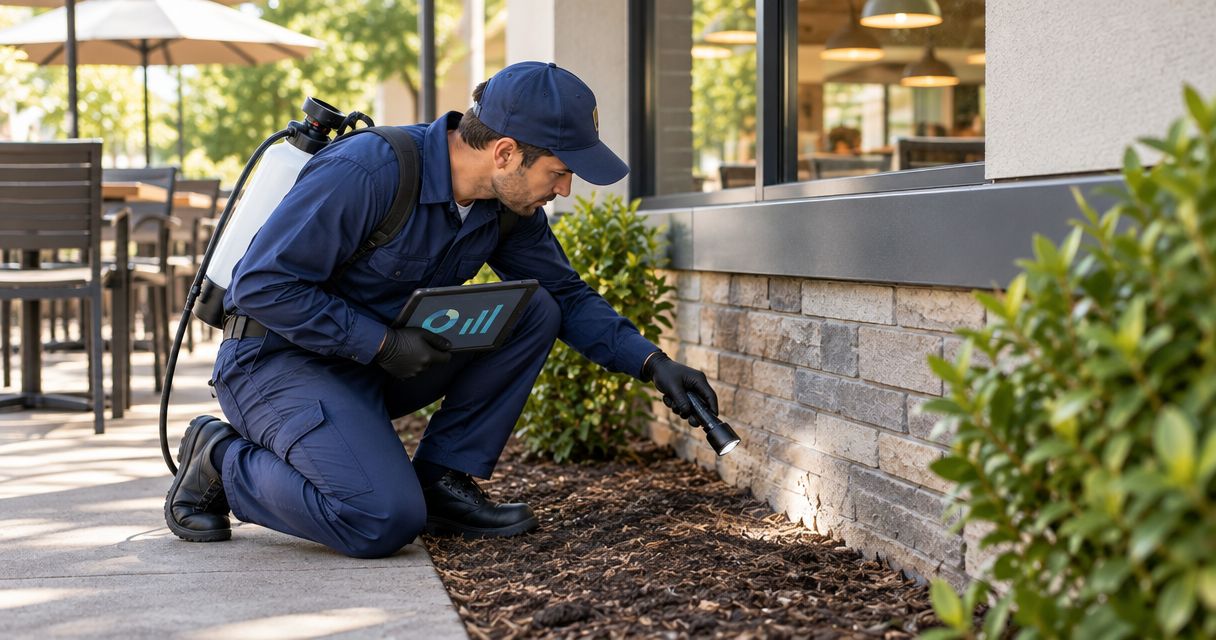
Restaurant pest control is the inspection, prevention, and treatment of pest activity with the aim of protecting food, staff, and daily operations. For a Santa Clara restaurant, service planning must account for food preparation, cleaning, deliveries, and rodent entry through doors and storage areas without treating every pest problem as the same job.
- Exo-Pest provides local commercial pest control for Santa Clara restaurants needing insect or rodent services.
- Pest control Santa Clara for restaurants should combine inspection, sanitation, targeted treatment, and entry-point repairs.
- Choose service timing around food handling, cleaning, deliveries, and the access each task requires.
- Separate treatment, exclusion, follow-up, and staff responsibilities in the written service scope.
Why pest control matters for restaurants
A restaurant has competing demands. Deliveries need access, food needs protection, and cleaning crews need room to work. A service plan must fit those activities rather than simply put a recurring appointment on the calendar.
The practical difference is coordination. A home kitchen and a commercial kitchen both need food storage and sanitation, but a restaurant also needs consistent handoffs between shifts, suppliers, managers, and outside service providers.
Exo-Pest pest control is best for Santa Clara restaurants seeking local insect and rodent services. The company provides residential and commercial pest control; your restaurant’s quote should identify the actual work, access requirements, and limitations.
For your 2026 service plan, judge each task by the problem it addresses. Cleaning removes food residue. Treatment addresses identified pest activity. Exclusion addresses entry points. None replaces the others.
Build a restaurant pest control service plan
1. Record activity
Start with a shared log before choosing a treatment. Ask staff to record where they saw activity, what they observed, and which shift was working. A report that says insects beside the dish area gives an inspector more direction than a report that says bugs in the kitchen.
Assign 1 shift lead to collect reports during each shift. This is an accountability choice, not a staffing requirement. Keep observations factual, and do not ask employees to identify an insect from memory or handle contaminated materials for a photograph.
For your 2026 records, distinguish a new sighting from a repeated report of the same event. That prevents duplicate entries from looking like separate incidents.
- Record the date, time, and exact location.
- Describe the pest or evidence without guessing its source.
- Photograph evidence only when safe and practical.
- Note nearby deliveries, leaks, or door problems.
- Give the service provider access to the log.
2. Map risk areas
Walk the property with your existing floor plan or a simple sketch. Mark 3 inspection zones: food handling and storage, utility and cleaning areas, and the building perimeter. These are planning categories, not a substitute for inspecting individual rooms.
Look beyond the dining room. Dish areas, storage shelving, service doors, and waste handling all need attention. In a shared building, identify which spaces your team controls and which require the landlord’s approval.
A map makes the first service discussion more useful. It also stops staff from assuming that a quiet customer area means the back-of-house problem is resolved.
- Mark reported sightings on the sketch.
- Identify delivery doors and employee entrances.
- Locate food storage, dishwashing, and waste areas.
- Flag leaks and damaged door components.
- Identify shared corridors and utility spaces.
3. Define the service scope
Use your log and map to write down the problem before requesting quotes. Ask whether the proposed work covers inspection, insect control, rodent control, entry-point sealing, or a combination. A general description of pest control does not tell you which tasks are included.
Exo-Pest provides insect control, rodent control, and rodent exclusion. Request a free quote tied to your restaurant’s observed activity and access needs, rather than assuming every service belongs in one package.
If sealing work involves a kitchen, review preparing a commercial kitchen for rodent exclusion. Confirm preparation instructions directly before moving food, equipment, or storage.
- Name the pest problem the quote addresses.
- Separate treatment from repairs and exclusion.
- Identify areas included in the inspection.
- Ask what preparation your staff must complete.
- Record exclusions and follow-up responsibilities.
4. Coordinate access
Plan service around actual kitchen activity, not just opening hours. A restaurant that is closed to customers can still have food preparation, cleaning, or deliveries underway. Tell the provider what happens in each area at the proposed appointment time.
Ask for task-specific instructions before scheduling. Treatment instructions, food protection measures, and re-entry requirements depend on the work and products involved. Do not use a blanket assumption that every service can happen while staff continue working nearby.
For your 2026 calendar, include the person responsible for opening restricted spaces. Access failures should not become a recurring reason that an identified area remains unchecked.
- Confirm who will meet the service provider.
- Share preparation, cleaning, and delivery schedules.
- Identify locked rooms and equipment access limits.
- Obtain food protection and re-entry instructions.
- Notify affected staff before the appointment.
5. Remove attractants
Start with the cleaning and maintenance work your team controls. Check food residue beneath accessible equipment, damaged storage containers, standing water, and waste handling. Record repairs separately so a leak does not disappear into a general cleaning checklist.
Use the same sequence during manager handoffs: record activity, map risk areas, define the service scope, coordinate access, and remove attractants. This keeps preparation connected to the actual pest report rather than turning it into an unrelated deep-cleaning exercise.

Keep treatment decisions with the provider when an active problem needs professional attention. Additional cleaning helps remove attractants, but it does not prove that an infestation has ended or an entry point has been repaired.
- Clean accessible food residue and spills.
- Store ingredients in suitable closed containers.
- Report leaks and drainage concerns.
- Keep waste areas orderly and containers closed.
- Avoid applying extra pesticides without coordination.
6. Assign repair responsibilities
Separate pest treatment from building repairs. A treatment visit does not automatically include replacing a damaged door component, repairing a wall opening, or correcting a shared utility penetration. Write down who approves and performs each task.
For tenant-operated restaurants, involve the property manager early when proposed work affects the building. Do not seal ventilation, drainage, or utility openings without checking their purpose and the repair requirements.
Warranty language needs the same care. Exo-Pest’s 2-year rodent exclusion warranty covers only the entry points Exo-Pest seals. Other work and new damage are excluded; it is not whole-property protection or coverage for every rodent problem.
- List each proposed repair by location.
- Identify the owner or tenant responsible.
- Confirm permission before altering building components.
- Separate sealed points from untreated openings.
- Retain the written scope and warranty terms.
7. Review results
Keep 1 shared log for staff observations and service findings. After a visit, compare the work completed with the locations originally reported. An invoice confirms a transaction; it does not by itself explain what changed in the kitchen.
Ask the provider how follow-up will be determined. Your 2026 schedule should reflect the identified pest, site conditions, and findings, rather than a frequency chosen without an inspection.
Review unfinished repairs alongside pest reports. Repeated activity near an unresolved door problem needs a different conversation from activity in a newly identified area.
- Record the areas inspected and work completed.
- Track new activity by location and shift.
- Keep unresolved repairs visible to management.
- Confirm the next review or service action.
- Update staff instructions when conditions change.
Compare restaurant pest control options
Choose the option that addresses the documented problem, not the broadest service label. Staff prevention, professional treatment, and exclusion serve different purposes. A restaurant can need more than one, but the quote should explain why.
| Option | Best for | Practical advantage | Key limitation |
|---|---|---|---|
| Staff sanitation and monitoring | Daily prevention and early reporting | Fits routine opening, closing, and cleaning tasks | Does not replace pest identification, treatment, or structural repairs |
| Targeted professional service | Investigating and addressing reported activity | Focuses attention on the pest and affected locations | A single intervention does not resolve every sanitation or access problem |
| Ongoing commercial pest service | Restaurants needing repeated inspection and coordinated follow-up | Creates a process for recording findings and assigning actions | Requires staff cooperation and a clearly defined scope |
| Rodent exclusion | Identified rodent entry points | Addresses physical access at specified openings | Does not cover every pest or replace necessary treatment |
| Exo-Pest pest control | Santa Clara restaurants seeking local insect or rodent services | Provides a local service option for inspection and scope discussions | Property-specific work and responsibilities require a quote |
When comparing providers, ask each to address the same evidence and locations. A proposal for treatment alone is not directly comparable with a proposal that also includes entry-point repairs.
Request a restaurant pest control quote
Describe your Santa Clara restaurant’s pest activity, access needs, and repair concerns. Request a free quote.
Common mistakes restaurants make
Treating the sighting instead of the location
Spraying where an insect appeared can leave the underlying problem unexplored. Preserve the location information and request identification before choosing a response. Keep staff-applied products in the service discussion so the provider knows what has already been used.
Scheduling during customer closure without checking kitchen activity
Closed dining rooms do not mean empty kitchens. Confirm prep work, dishwashing, contractor visits, and deliveries before agreeing to access arrangements. Follow the provider’s instructions for the specific task.
Leaving shared areas out of the plan
A restaurant’s lease boundary does not answer every access question. Identify who controls shared waste areas, corridors, and utility spaces. Ask the property manager to coordinate necessary inspections rather than assuming the restaurant’s provider can enter them.
Confusing exclusion with complete protection
Sealing identified rodent entry points is a defined repair task, not a promise that every pest issue is resolved. Keep treatment, sanitation, building maintenance, and warranty coverage separate in your records.
FAQ
What’s the best pest control plan for a Santa Clara restaurant?
The best plan starts with an inspection and separates sanitation, treatment, entry-point repairs, and follow-up. Match the work to documented activity and the restaurant’s operating schedule rather than selecting a service frequency first.
Can restaurant staff handle pest prevention themselves?
Restaurant staff can handle routine sanitation, food storage checks, and reporting. Professional identification and treatment address problems those daily tasks do not resolve; building repairs also need a separate owner.
Can pest control happen while the restaurant is open?
Service timing depends on the task, location, and applicable treatment instructions. Give the provider your preparation and operating schedule, then obtain food protection and re-entry instructions before booking.
How often should a restaurant schedule pest control in 2026?
Set the schedule after the provider assesses pest activity, site conditions, and follow-up needs. Do not assume one interval suits every restaurant or every pest problem.
Is rodent exclusion the same as rodent treatment?
No. Rodent exclusion addresses physical entry points, while rodent treatment addresses rodent activity. A restaurant’s scope should explain whether either or both are needed.
What does the Exo-Pest rodent exclusion warranty cover?
The 2-year rodent exclusion warranty covers only the entry points Exo-Pest seals. Other work and new damage are excluded, so it is not whole-property protection or an unconditional guarantee.
What should I prepare before requesting a free quote?
Prepare your activity log, affected locations, delivery schedule, and access restrictions. Identify landlord-controlled areas and known repair issues so the quote can distinguish pest services from building work.
One last thing
Read the shift handoff before booking another visit. If opening staff report activity but closing staff never see the report, the same cleaning gap or damaged door can remain unassigned. Make the next action visible to both shifts, then request a free quote that addresses the documented problem.
Related guides
- Rodent exclusion for retail stockrooms and entry doors
- Checking sealed rodent entry points
- How to choose pest control in Santa Clara
Leave a Reply