
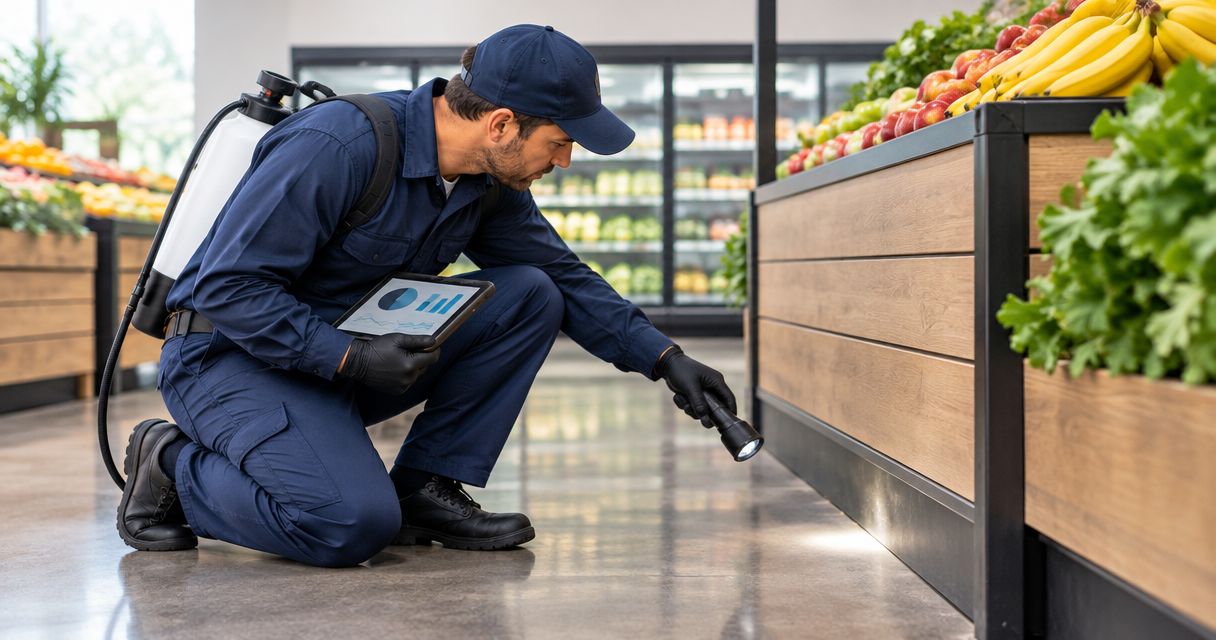
Grocery store and retail pest control is the inspection, prevention, and treatment of pests with the aim of protecting merchandise, food-handling areas, and daily operations. This 2026 guide explains how to manage deliveries, stockrooms, customer areas, and shared building access without treating every pest problem the same way.
- Pest control for grocery stores and retailers needs separate plans for receiving, storage, food handling, and customer areas.
- Exo-Pest provides commercial pest control for property owners in Santa Clara, San Mateo, and Alameda counties.
- Separate active pest treatment from entry-point sealing; neither replaces cleaning and stock inspection.
- Request a property-specific scope that assigns responsibilities to store staff, the pest provider, and building management.
Why pest control matters for grocery stores and retailers
A grocery store combines food, packaging, deliveries, waste, and frequent door use. A nonfood retailer still has receiving areas, employee food, stored cartons, and utility openings. The inspection must follow those conditions rather than stop at the sales floor.
Exo-Pest pest control is best for local residential and commercial property owners seeking service in Santa Clara, San Mateo, and Alameda counties. For a store-specific discussion, contact Exo-Pest and describe the affected areas before requesting a free quote.
Your 2026 pest plan should connect each finding to an action and an owner. A damaged door sweep belongs on the repair list; contaminated merchandise needs a handling decision; recurring pest activity needs investigation. A treatment visit does not replace those separate tasks.
How to build a store-specific pest control plan
1. Map your store
Start with a printed floor plan or a hand-drawn sketch. Mark receiving doors, food storage, drains, break rooms, waste areas, and the locations of recent sightings. Record evidence where staff found it, not just where customers noticed a pest.
For a grocery store, distinguish packaged goods from exposed food and preparation areas. For a clothing or hardware retailer, include returns storage, seasonal displays, and employee lockers. Keep inaccessible spaces on the map so someone can arrange access rather than quietly omit them.
Use three practical inspection zones: receiving, storage, and occupied areas. These are a starting structure, not a limit on the inspection.
- Mark every delivery and customer entrance.
- Separate food preparation from packaged-goods storage.
- Identify wall, ceiling, and utility access points.
- Record shared corridors and neighboring tenant boundaries.
- Assign a staff contact for restricted areas.
2. Record evidence before choosing treatment
Use a shared paper log or spreadsheet before buying supplies or scheduling treatment. Include the date, exact location, observed evidence, and any affected merchandise. A photograph taken from a safe distance gives the pest professional more information than a report that something was seen somewhere near receiving.
Match the response to the pest and the location. Ant activity near a break-room sink calls for a different investigation than rodent droppings beside damaged stock. Do not sweep up suspected rodent waste as part of ordinary dry cleaning; isolate the area and follow appropriate public-health cleanup guidance.
Make reporting part of the same shift in which staff discover a problem. This is an operating rule you can adopt, not a promise that every issue can be resolved within one shift.
- Record sightings against the store map.
- Photograph damaged packaging without handling suspect material.
- Separate affected goods from sale pending a handling decision.
- Note leaks, spills, and open doors nearby.
- Give the log to the person arranging service.
3. Define the service scope
Write down what staff can handle first: stock checks, spill removal, access arrangements, and repair reporting. Then ask Exo-Pest to assess the pest-control work. A professional assessment gives you a route from evidence to a property-specific scope instead of asking employees to select treatment by guesswork.
A 2026 service request should distinguish inspection, treatment, entry-point sealing, and follow-up. These are different tasks. Rodent exclusion addresses access openings; it does not automatically resolve rodents already inside or remove food sources.
If rodent exclusion is proposed, read the coverage narrowly. Exo-Pest's 2-year rodent exclusion warranty covers only the entry points it seals. Other work and new damage are excluded; the warranty is not whole-property protection.
- Inspection: identify evidence, affected areas, and access needs.
- Treatment: specify the pest and locations being addressed.
- Entry-point sealing: identify the openings included in the work.
- Follow-up: define what will be checked and who reports changes.

4. Tighten receiving and stock handling
Begin with a receiving checklist that employees can use without special software. Inspect accessible carton surfaces, check for damaged packaging, and avoid moving questionable deliveries straight onto shelves. Record the supplier and receiving location when a delivery needs further review.
Grocery staff should also check storage conditions and follow the store's food-safety procedures when deciding what to isolate or discard. Nonfood retailers should inspect returned goods and long-stored cartons rather than assuming that only edible stock needs attention.
Give receiving staff a clear escalation path. They should know who can pause acceptance, where suspect goods belong, and who contacts the supplier or pest provider. Do not leave that decision to whoever happens to be unloading.
- Check packaging before stock enters its normal storage area.
- Keep suspect deliveries separate while a manager reviews them.
- Remove unnecessary empty cartons from storage.
- Keep inspection routes accessible around stored goods.
- Record supplier and delivery details for recurring findings.
5. Inspect doors and building openings
Start with a visual door check during normal operations. Look for damaged sweeps, doors that fail to close, and gaps around service penetrations. Report the location and condition rather than directing employees to seal unfamiliar openings themselves.
Storefront doors are only part of the boundary. Receiving areas, roof access, shared utility spaces, and adjoining units also deserve attention where accessible. Use the guide to rodent exclusion for retail stores, stockrooms, and entry doors to frame the discussion around the store's actual access points.
Do not block ventilation, drainage, or required exit operation to close a pest gap. Ask the appropriate contractor or pest professional to assess repairs where building functions are involved.
- Check that delivery doors close after unloading.
- Photograph damaged sweeps and visible perimeter gaps.
- Assign shared-building defects to the property manager.
- Arrange access before inspecting concealed spaces.
- Recheck repaired openings after maintenance work.
6. Schedule service around food and people
Use the store calendar to identify delivery windows, food preparation, cleaning, and customer access. Send those details when requesting service. Do not assume that work can happen beside exposed food or while employees continue using every affected area.
Keep your 2026 service instructions with the store's operating records. Ask which goods must be moved or protected, which areas require restricted access, and what conditions allow staff to resume normal use. Follow the selected product's label and the provider's instructions; a generic waiting period is not a substitute.
For a shared retail site, confirm who can open utility rooms and authorize work outside the leased unit. A booked visit is not an access agreement.
- Name a manager who can authorize access.
- Identify exposed food and food-contact equipment.
- Confirm preparation tasks before the visit.
- Ask for treatment-specific access and re-entry instructions.
- Tell the next shift about any restrictions still in place.
7. Assign cleaning and repair handoffs
Finish the plan with a responsibility sheet, not another general instruction to keep the store clean. Separate spill response, waste handling, drain maintenance, door repairs, pest reporting, and treatment decisions. Give each task an owner and a way to confirm completion.
In a shopping centre, responsibility can cross the store boundary. When choosing a commercial cleaning contractor, define who cleans shared waste areas, reports leaks, and communicates pest evidence to tenant managers. Cleaning removes food residues and debris; it does not replace pest identification or repairs to entry points.
Review the reporting log after corrective work. A completed repair and a continuing sighting are not contradictory: they mean the remaining activity still needs investigation. Ask staff to report evidence without guessing whether a treatment has succeeded or failed.
- Assign spill and waste responsibilities by area.
- Separate tenant repairs from landlord repairs.
- Require confirmation when a reported defect is repaired.
- Share relevant findings with cleaning and maintenance contacts.
- Keep unresolved items open until someone verifies the next action.
Compare your 2026 pest-control options
Choose options by the problem they address, not as substitutes for one another. Routine store work supports prevention. Professional pest control addresses findings within an agreed scope. Exclusion addresses specified access points.
| Option | Best for | Main benefit | Key limitation |
|---|---|---|---|
| Staff inspection and sanitation | Daily prevention and early reporting | Fits receiving, cleaning, and shift routines | Does not replace pest identification or professional treatment |
| Professional pest inspection and treatment | Active evidence that needs assessment | Connects findings to a targeted response | Does not automatically include structural repairs or exclusion |
| Rodent exclusion | Identified rodent entry points | Addresses physical access through specified openings | Does not remove food sources or resolve every existing rodent problem |
| Building maintenance and landlord coordination | Shared doors, utility areas, and structural defects | Assigns repairs beyond the store team's authority | Requires access and authorization; it is not pest treatment |
Ask Exo-Pest to explain the proposed service, preparation requirements, exclusions, and follow-up before authorizing work. Request a free quote for your property rather than assuming another store's scope applies to yours.
Request a store pest-control quote
Describe your store, pest evidence, and access needs for a property-specific free quote.
Common mistakes grocery stores and retailers make
Treating the sales floor as the entire problem
A clean aisle does not tell you what is happening behind receiving stock or inside a shared service area. Inspect the route merchandise takes through the building, including returns and waste handling.
Releasing questionable goods without a decision
Moving a damaged carton away from receiving does not resolve its condition. Assign a manager to decide how affected goods are handled under the store's food-safety or merchandise procedures.
Asking cleaning staff to diagnose pests
Cleaners can report evidence and address assigned cleaning tasks. Pest identification, treatment selection, and structural repairs need separate decisions. Do not let an unclear contract turn a sighting into an unassigned problem.
Closing repairs without checking operation
A door repair needs a functional check, not just a completed invoice. Confirm that the door closes properly and that any sealing work preserves required ventilation and exit operation.
Reading a limited warranty as blanket coverage
A warranty for specified sealed entry points is not coverage for every rodent problem. Keep the written scope with the repair record so managers can distinguish covered work from new damage or unrelated defects.
FAQ
What’s the best pest-control approach for a grocery store?
Combine routine inspection and sanitation with pest-specific professional assessment and repairs to identified access points. Receiving, food storage, preparation, and waste areas need distinct responsibilities rather than one general checklist.
Do nonfood retailers need pest control too?
Nonfood retailers need pest prevention and a response to evidence of activity. Receiving doors, stored cartons, employee food, and shared building openings belong in the inspection plan even when the store does not sell groceries.
Can grocery store employees handle pest control themselves?
Employees can inspect deliveries, record sightings, remove food residues, and report repairs. Professional assessment is the appropriate next step when pest identification, treatment selection, or exclusion work exceeds those routine duties.
Can pest treatment take place while the store is open?
Access restrictions depend on the treatment, location, product label, and provider’s instructions. Confirm the work area and re-entry conditions before scheduling; do not assume every service requires closure or permits normal operation.
Does rodent exclusion eliminate every rodent problem?
No. Rodent exclusion addresses specified entry points, while existing activity, food sources, and other openings require separate attention. A store plan should distinguish sealing work from treatment and sanitation.
Who handles pest problems in a shared shopping centre?
Assign responsibility using the lease, service agreements, and the location of the problem. Store management, the landlord, cleaners, maintenance staff, and the pest provider need clear handoffs for shared areas and repairs.
What should I prepare before requesting a commercial pest-control quote?
Prepare your store location, pest evidence, affected areas, access restrictions, and known building defects. Photographs and a simple floor plan help define the inspection discussion without requiring employees to diagnose the pest.
One last thing
Add pest checks to your 2026 receiving checklist, not just your cleaning checklist. Receiving is a point where staff can inspect goods before distributing them throughout the store. Give employees a clear hold-and-report procedure, so questionable stock triggers a decision rather than simply changing location.
Related guides
- Rodent exclusion for commercial buildings with shared walls
- Rodent exclusion for warehouses, loading areas, and access gaps
- Pest control for restaurants: service planning
Leave a Reply