
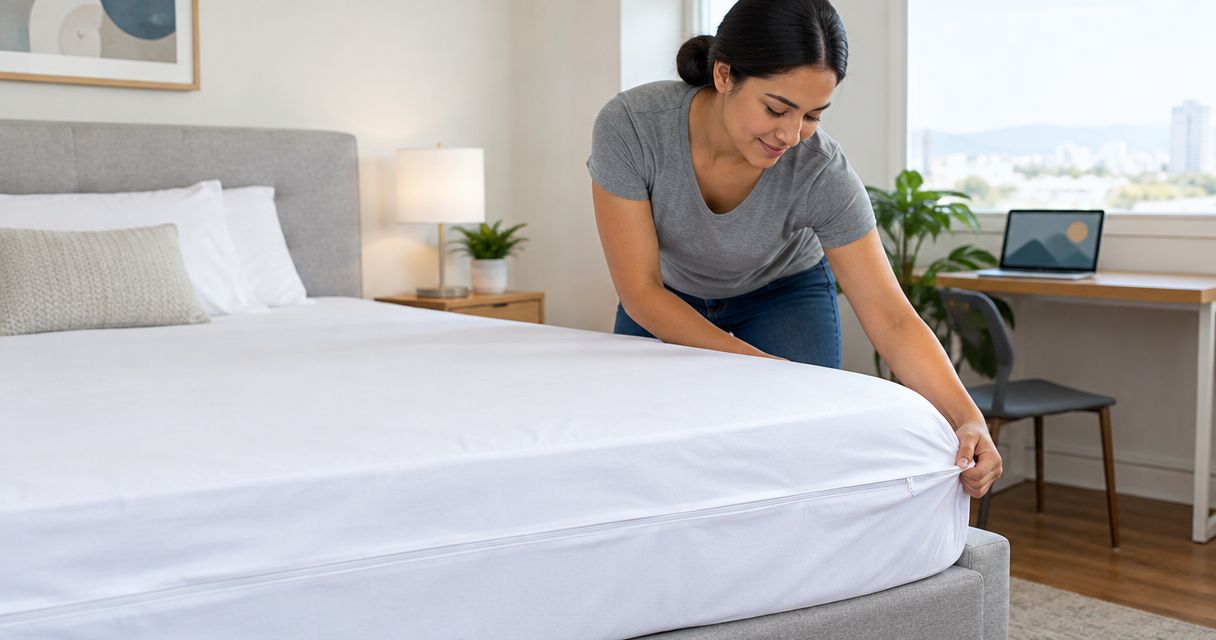
Best overall: a fully zippered, bed-bug-specific mattress encasement matched to your mattress. Best for thick mattresses: a deep-profile encasement. Best for spill-prone beds: a waterproof encasement also designed for bed bugs. This 2026 guide helps San Jose renters compare those options, protect a box spring, and coordinate the next steps with their landlord.
- The best bed bug mattress encasements for San Jose rentals fully enclose the mattress and have a protected zipper closure.
- Choose mattress depth and closure design before waterproofing or comfort features.
- A box-spring encasement protects the foundation; it does not replace a mattress encasement.
- Exo Pest is a local pest-control option for San Jose renters seeking a property-specific quote.
- An encasement supports bed bug management; it does not treat an entire rental.
Why this matters
A fitted mattress protector leaves the underside open. A bed bug encasement surrounds the entire mattress, creating a barrier that contains bed bugs already inside an intact cover and limits access to the mattress itself. Bed bugs can still occupy the frame, headboard, furniture, or other hiding places.
For San Jose rentals in 2026, the purchase belongs inside a property-level plan, not in place of one. Notify your landlord or property manager about suspected activity, preserve useful evidence, and agree on access before treatment or furniture movement. If you need help defining the scope, Exo Pest provides residential and commercial pest-control services.
What makes the best bed bug mattress encasement
Compare these features before choosing extras. A waterproof surface cannot compensate for an open underside or an unprotected zipper end.
- Complete enclosure: The cover must surround the mattress, not just its top and sides.
- Bed bug purpose: Look for explicit bed bug containment or exclusion information, rather than assuming an allergy cover does the same job.
- Protected closure: Examine how the zipper closes and how its end is secured. Follow the manufacturer's closure instructions.
- Correct dimensions: Match length, width, and depth to the manufacturer's stated fit range.
- Care and durability: Check cleaning instructions, seam construction, and precautions against punctures from the bed frame.
- Inspection access: Choose a surface and setup you can inspect without repeatedly removing the encasement.
Choose the encasement that fits securely and stays intact, not the one with the longest feature list. These recommendations rank encasement types by use case; they do not claim that named products have passed testing.
Best encasement options at a glance
These categories overlap: a deep-profile encasement can also be waterproof. Use the table to identify your main requirement, then verify the individual product's fit and bed bug instructions.
| Rank and option | Best for | Standout feature to verify | Key limitation |
|---|---|---|---|
| 1. Fully zippered mattress encasement | A mattress within the listed standard fit range | Complete enclosure with a protected zipper closure | Does not address bed bugs elsewhere in the room |
| 2. Deep-profile mattress encasement | A thick mattress outside a standard cover's fit range | Sufficient depth without stretching seams or the closure | Extra fabric can bunch when the mattress is too shallow |
| 3. Waterproof bed bug mattress encasement | A bed that also needs liquid protection | Both a waterproof barrier and explicit bed bug protection | Waterproofing alone does not establish bed bug protection |
| 4. Box-spring encasement | A bed with an exposed box spring | Full enclosure sized for the foundation | Does not protect the mattress above it |
1. Fully zippered encasement: best for a standard-fit mattress
A fully zippered mattress encasement is the default choice when your mattress falls within its stated dimensions. It surrounds every side of the mattress and closes around it, unlike a fitted protector with an elastic skirt.
For a 2026 purchase, read the closure instructions before ordering. Product photos showing only the sleeping surface do not explain how the underside or zipper end is protected.
Fully zippered encasement pros:
- Covers the top, sides, and underside of the mattress.
- Separates the mattress interior from the surrounding room when intact and correctly closed.
- Provides an exterior surface you can inspect for damage or signs of activity.
Fully zippered encasement cons:
- Does not remove bed bugs from furniture, floor edges, or the bed frame.
- Loses its barrier function if torn or left partly open.
- Requires lifting and handling the mattress during installation.
Best for: Renters whose mattress dimensions match the listed fit range and who do not need a special depth or liquid-protection feature.
Verdict: Buy a bed-bug-specific, fully enclosing cover after confirming dimensions and the landlord's treatment plan.
2. Deep-profile encasement: best for a thick mattress
A deep-profile encasement serves the same containment purpose as the default option but accommodates a thicker mattress. The relevant measurement is the mattress you will actually enclose, not the bed's overall height from the floor.
Do not force a shallow cover over a thick mattress. A strained seam or zipper defeats the reason for choosing a protective enclosure.
Deep-profile encasement pros:
- Accommodates mattress depths outside a standard cover's range.
- Avoids relying on stretched fabric to reach the zipper.
- Lets you choose full enclosure without replacing the mattress solely because of its thickness.
Deep-profile encasement cons:
- An oversized depth range can leave loose folds around a shallow mattress.
- Mattress toppers complicate fit if you assume they belong inside the same cover.
- The depth label does not verify bed bug protection; closure details still matter.
Best for: Renters with a thick mattress that exceeds the fit range of the standard option.
Check whether the manufacturer's instructions allow a topper inside the encasement, and coordinate with the pest professional before enclosing potentially affected bedding together.
Verdict: Buy when your measured mattress depth requires it; skip an oversized cover chosen without measuring.
3. Waterproof encasement: best for beds needing liquid protection
A waterproof bed bug mattress encasement combines liquid protection with complete enclosure. It fits a different need from a waterproof fitted pad: the product must also be designed to block bed bug passage through its fabric, seams, and closure.
For San Jose rental purchases in 2026, treat waterproofing as an added requirement, not evidence of pest protection. Verify both functions separately.
Waterproof encasement pros:
- Combines mattress enclosure and liquid protection in one cover.
- Suits beds where spills or other liquid exposure are a concern.
- Avoids depending on an open-bottom waterproof pad for bed bug containment.
Waterproof encasement cons:
- Waterproof claims alone say nothing about the zipper's protection.
- The barrier material can affect sleeping feel; review the stated construction.
- Care instructions can restrict washing or drying methods.
Best for: Renters who need liquid protection as well as a bed-bug-specific enclosure.
Read the care label before using heat or cleaning products. Do not apply pesticides to the encasement unless the pesticide label expressly permits that use.
Verdict: Buy when both functions are documented; skip a waterproof protector presented without complete-enclosure details.
4. Box-spring encasement: best for an exposed foundation
A box-spring encasement surrounds the foundation beneath the mattress. It addresses a separate part of the bed, so buying one does not eliminate the need to assess the mattress, frame, and headboard.
Confirm what supports your mattress before ordering. A platform bed without a box spring does not need a box-spring cover simply because it appears on a shopping checklist.
Box-spring encasement pros:
- Encloses a foundation with seams and internal spaces that are difficult to inspect.
- Adds a barrier around the box spring when intact and correctly closed.
- Supports a bed-level plan that addresses more than the sleeping surface.
Box-spring encasement cons:
- Does not enclose or protect the mattress above it.
- Can tear against exposed staples, sharp frame edges, or rough handling.
- Requires the correct foundation dimensions and safe lifting access.
Best for: Renters whose bed includes a box spring that the treatment plan calls for enclosing.
Check the supporting frame for contact points that could damage the cover. Ask for help rather than lifting a heavy foundation alone.
Verdict: Buy when a box spring is present and enclosure fits the plan; skip when the bed has no box spring.
How to fit an encasement into your rental's treatment plan
The useful sequence is document, coordinate, measure, install, inspect. Buying first and asking questions later can leave you with the wrong size or instructions that conflict with scheduled work.

Document
Photograph visible signs without moving affected items into shared areas. Record where and when you noticed them, and preserve a suspected insect safely for identification if possible. Bites alone do not confirm bed bugs.
Coordinate
Tell your landlord or property manager what you observed and request preparation instructions. Ask who will arrange access, assess adjoining areas when appropriate, and provide follow-up directions. Do not assume a product purchase settles responsibility for treatment.
Measure
Record the mattress length, width, and depth, then compare all dimensions with the product's fit range. Measure a box spring separately. Do not assume a familiar bed-size name guarantees the correct depth.
Install
Follow the manufacturer's instructions and the property's treatment directions. Avoid dragging the cover over sharp frame edges, and close the zipper fully using its specified end protection. Do not move an exposed mattress through common areas without an agreed handling plan.
Inspect
Check accessible seams, the zipper closure, and contact points for tears or gaps. Keep the encasement installed for the period directed by the pest professional and manufacturer; stopping visible activity is not a reason to remove it immediately.
Control, containment, and prevention are different jobs
An encasement is a containment tool, not a whole-room treatment. Bed bug control requires identifying activity and addressing the places where bed bugs are present; an encased mattress does not establish that the room is clear.
Rodent exclusion is a separate service that seals identified building entry points. It is not a substitute for bed bug management, and advice about sealing rodent openings should not be treated as an encasement instruction.
Exo Pest provides pest control, rodent exclusion, and crawlspace cleaning across Santa Clara, San Mateo, and Alameda counties. For a suspected bed bug issue, describe the signs and property type, then ask what assessment and service scope are appropriate. A free quote does not imply a free inspection, report, or treatment.
How these options are ranked
This 2026 guide prioritizes complete enclosure, protected closure, correct fit, and practical inspection. Waterproofing ranks as a use-specific feature rather than a reason to overlook those basics.
The default appears first because it addresses the core mattress-enclosure requirement. Deep-profile and waterproof covers address additional needs; the box-spring option addresses a different bed component. The ranking does not assign product performance scores or compare unverified brands.
Which encasement should you choose?
Choose a fully zippered, bed-bug-specific mattress encasement that matches your measured mattress. Select the deep-profile version only when depth requires it, add waterproofing when liquid protection matters, and assess a box spring separately.
Before ordering in 2026, ask your landlord or pest professional whether installation should happen before or after scheduled work. Keep the product instructions available so everyone follows the same closure and care requirements.
FAQ
What’s the best bed bug mattress encasement for a San Jose rental?
The best default is a fully zippered, bed-bug-specific encasement matched to the mattress dimensions. Verify complete enclosure, protected zipper closure, and care instructions before choosing extra features.
Can a mattress encasement get rid of bed bugs by itself?
No. A mattress encasement does not treat bed bugs in the frame, headboard, furniture, or other hiding places. Use it within a coordinated property-level management plan.
Is a waterproof mattress protector enough for bed bugs?
No. Waterproofing describes liquid protection, not bed bug containment. Choose a product that fully encloses the mattress and specifically addresses bed bug passage through the fabric and closure.
Should I tell my landlord before buying an encasement?
Yes. Report suspected activity and ask for the property’s preparation and access instructions before installing a cover. This helps coordinate the purchase with assessment and treatment work.
Do I need to encase the box spring too?
Assess the box spring separately if your bed has one. A mattress cover does not enclose the foundation, and a box-spring cover does not enclose the mattress.
How long should I leave a bed bug encasement on?
Leave the encasement installed for the period directed by the pest professional and manufacturer. Do not remove it simply because you stop seeing activity; inspect accessible surfaces without opening the enclosure.
Should I throw away a mattress if I suspect bed bugs?
Do not discard the mattress solely on suspicion. Ask for identification and a handling plan first, because unnecessary movement can carry bed bugs into other areas.
Can Exo Pest provide a quote for a San Jose rental?
Exo Pest serves homes and businesses in Santa Clara County, including San Jose. Share the observed signs and property details to request a property-specific quote; a free quote does not promise a free inspection, report, or treatment.
One last thing
The zipper end deserves the same attention as the fabric. A cover can surround the entire mattress and still leave an opening if its closure is not secured as directed.
Before you order, request a property-specific quote and share what you are seeing, where it appears, and whether your landlord has arranged an assessment. Ask how an encasement fits the proposed scope.
Leave a Reply