
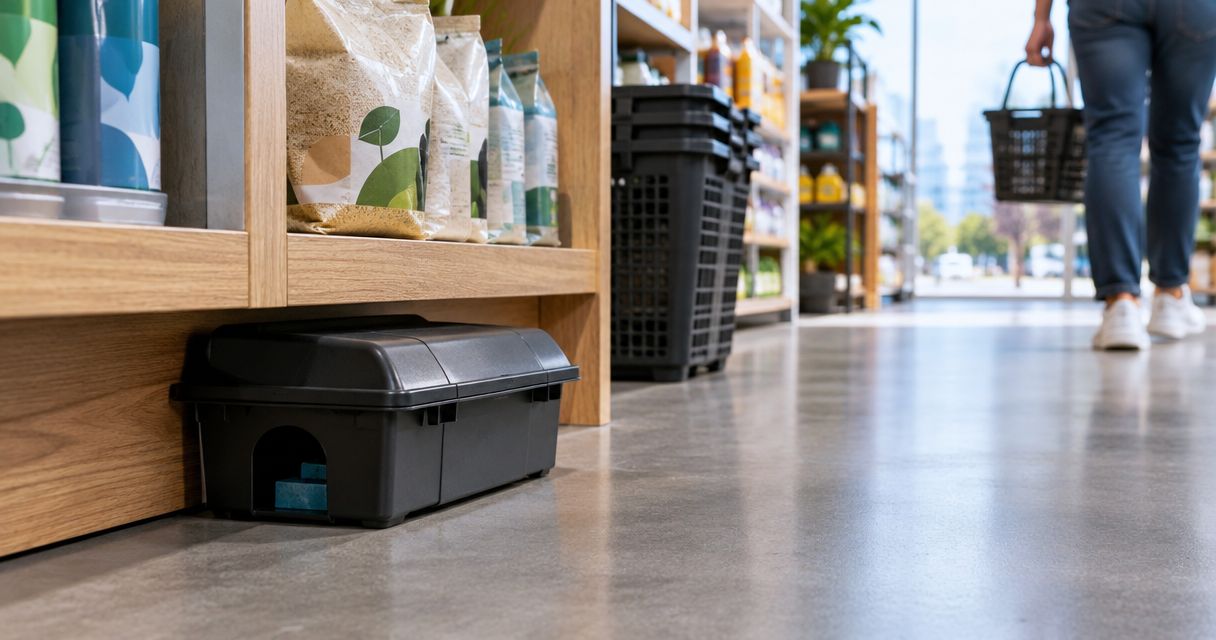
Best overall for exterior bait placement: a secured, tamper-resistant station suited to the location and bait label. Best for indoor capture: an enclosed snap-trap station. Best for checking suspected activity: a non-toxic monitoring station. For San Jose retail stores in 2026, choose the equipment by its job—not by how many boxes fit around the building.
- The best rodent bait stations San Jose retail stores choose must match the location, access risks and intended use.
- Exterior bait stations contain bait; enclosed trap stations capture rodents. They are not interchangeable.
- Non-toxic monitoring stations help check activity but do not replace rodent control or entry-point repairs.
- Exo Pest suits San Jose retailers seeking a property-specific rodent-control and exclusion scope.
Why this matters
A station is a container, not a complete rodent-control plan. Its contents, placement, servicing and relationship to the building's entry points determine whether it addresses your problem.
Start with the signs you can describe: damaged packaging, droppings, sightings or repeated activity near a receiving door. The rodent control in San Jose guide provides related context; this comparison focuses on selecting station types for a retail property.
Control addresses current rodent activity. Exclusion addresses identified entry points. Buying more stations does not repair a door gap or settle responsibility for a shared loading area.
What makes the best rodent station for a retail store?
Use these criteria when comparing equipment for your 2026 plan:
- Purpose: Decide whether you need bait placement, mechanical capture or monitoring. A box alone does none of those jobs.
- Access protection: Match the enclosure to customer, employee, child, pet and wildlife access. Tamper-resistant does not mean harmless.
- Location suitability: Check whether the equipment and its contents are intended for the proposed indoor or outdoor location.
- Secure placement: Confirm how the station stays in its assigned position without creating an obstruction or trip hazard.
- Service access: Staff or the responsible provider must be able to inspect, identify and service the equipment safely.
- Clear records: Record the station's location, purpose, observations and corrective actions. An unrecorded box is difficult to evaluate.
For pesticide-containing stations, follow the product label and applicable California requirements. Do not assume a bait is permitted at your property because it fits inside a station.
Retail rodent stations at a glance
This guide compares 4 equipment types, not individual product models. Only the first category is necessarily a bait station; the others address different retail needs without treating every rodent problem as a reason to use poison.
| Equipment type | Best for | Standout feature | Key limitation |
|---|---|---|---|
| Secured exterior bait station | Label-permitted exterior bait placement | Protective enclosure for compatible bait | Does not capture rodents or seal entry points |
| Enclosed snap-trap station | Indoor capture in protected service locations | Houses a mechanical trap within an enclosure | Requires checks and safe removal of captured rodents |
| Non-toxic monitoring station | Investigating suspected activity near receiving areas | Holds non-toxic monitoring material | Monitors activity rather than controlling a population |
| Enclosed multiple-catch mouse trap | Repeated mouse capture in a staffed backroom | Designed to capture more than one mouse between services | Mouse-specific; capture mechanism and servicing needs vary |
The ranking separates use cases rather than declaring one enclosure suitable for every store. None should obstruct an exit, customer route or required equipment access.
1. Secured exterior bait station: best for exterior bait placement
A secured, tamper-resistant exterior station holds compatible rodent bait in a protective enclosure. Choose this category only when the proposed bait, placement and use comply with the label and applicable requirements.
For a San Jose retailer, the first decision is responsibility. Establish who controls the exterior location, who authorizes the work and who services the station—especially at a shopping center with shared walkways or waste areas.
Exterior bait station pros:
- Provides an enclosure designed to restrict access to its contents.
- Gives the responsible provider a defined location to inspect.
- Supports recorded bait observations when included in a service plan.
Exterior bait station cons:
- Does not eliminate exposure risks simply because it locks.
- Does not prevent rodents from entering an unsealed building.
- Bait use depends on the specific product and permitted application.
Best for: Exterior locations where a responsible provider has established that bait use is appropriate and permitted.
Ask what the station contains and how it will be secured. A weather-resistant enclosure does not make every bait suitable for outdoor use.
Verdict: Buy only after the location, compatible contents and servicing responsibility are confirmed.
2. Enclosed snap-trap station: best for indoor capture
An enclosed snap-trap station houses a mechanical trap rather than relying on rodenticide. It serves a different purpose from a bait station: capturing a rodent at the trap location.
This category deserves consideration when your objective is indoor capture. Select equipment designed for the target rodent, and keep it away from casual customer or employee handling.
Enclosed snap-trap station pros:
- Provides a defined capture location.
- Supports mechanical control without rodenticide when used without pesticide bait.
- Places a protective enclosure around the trap mechanism.
Enclosed snap-trap station cons:
- Requires regular inspection and safe handling of captures.
- An enclosure does not make incorrect placement effective.
- Trap mechanisms still require access precautions.
Best for: Protected indoor service locations where mechanical capture is the agreed objective.
Confirm who checks the station during weekends, closures and staff changes. An installed trap without an assigned service routine leaves an important part of the work unfinished.
Verdict: Buy for an indoor capture plan with a named person or provider responsible for checks.
3. Non-toxic monitoring station: best for checking receiving-area activity
A non-toxic monitoring station contains material intended to help detect feeding or disturbance, without a rodenticide active ingredient. Its role is observation—not population control.
Use this category when you need to investigate suspected activity around receiving or storage areas. Interpret the observations alongside other signs; missing or disturbed material alone does not establish the full extent of a rodent problem.
Non-toxic monitoring station pros:
- Supports monitoring without adding rodenticide.
- Creates a repeatable location for inspection.
- Helps organize observations by area rather than relying on memory.
Non-toxic monitoring station cons:
- Does not capture rodents or close access points.
- Monitoring material still needs appropriate placement and handling.
- Observations require interpretation before choosing corrective work.
Best for: Receiving areas with uncertain activity that needs investigation and documentation.
In a 2026 equipment review, distinguish a station labelled for monitoring from one being used for active control. Staff should know which job each box performs.
Verdict: Buy for monitoring; skip it as a stand-alone solution to confirmed rodent activity.
4. Enclosed multiple-catch mouse trap: best for staffed backrooms
An enclosed multiple-catch mouse trap is designed to capture more than one mouse between servicing. Designs differ, so confirm whether the particular model captures mice alive and what checking and handling it requires.
This is a mouse-control option, not a substitute for rat-sized equipment. A staffed backroom is a useful decision category because someone must own the inspection routine rather than assume the device operates unattended indefinitely.
Multiple-catch mouse trap pros:
- Supports capture without rodenticide when used without pesticide bait.
- Allows more than one mouse capture between services by design.
- Provides a fixed location for recording capture activity.
Multiple-catch mouse trap cons:
- Does not address rats or building entry points.
- Live-capture designs require a clear, humane handling plan.
- Capacity does not remove the need for checks.
Best for: Confirmed mouse activity in a backroom with dependable inspection and servicing.
Ask how captures will be handled before selecting the equipment. Do not delegate that decision to whichever employee happens to open the store.
Verdict: Buy only for a confirmed mouse problem with a workable servicing plan.
How the station types are ranked
The order follows distinct retail tasks: exterior bait placement, indoor capture, activity monitoring and repeated mouse capture. The criteria are purpose, access protection, location suitability, secure placement, service access and records.
This is a category comparison, not a product-performance test. No enclosure earns a recommendation simply because it has a lock, and no station type replaces inspection of the property's identified entry points.
Review the property before choosing equipment
For your 2026 review, walk through 3 zones: the customer area, backroom and exterior. Describe what you see without moving suspect material or opening unfamiliar stations.
Customer area
Identify public access and merchandise exposure. Note where a customer, child or visiting pet could reach equipment, and keep proposed locations clear of circulation routes.
Backroom
Record sightings, damaged packaging and the relationship between storage and receiving doors. Identify who can access the area and who can check equipment during normal operations.
Exterior
Note visible openings, door conditions and shared service areas. Confirm whether the landlord, property manager or tenant controls each location before arranging work there.
A useful sequence is Record signs, Review access, Agree scope, Assign checks. These steps connect equipment selection to the actual property rather than an arbitrary station count.

Keep control and exclusion separate in the scope
Rodent control and rodent exclusion answer different questions. Control addresses current activity; exclusion closes the identified openings included in the agreed work.
Ask for both to be explained separately. A capture record tells you about rodents caught, not whether a receiving-door opening has been corrected.
Exo Pest provides residential and commercial pest control, rodent exclusion and crawlspace cleaning in Santa Clara, San Mateo and Alameda counties. For a retail property, request a property-specific scope rather than assume every service belongs in the same job.
Keep 2 documents together: the agreed scope and the station location record. Use the scope to check what work was authorized and the location record to understand what each installed device does.
For shared properties, name the party responsible for building repairs. Station servicing and correcting a damaged door are separate tasks, even when both address the same activity.
Which rodent station should your store choose?
Choose an enclosed snap-trap station when the agreed task is indoor capture; choose a secured exterior bait station only for appropriate, permitted bait placement. Use non-toxic monitoring to investigate activity, and reserve multiple-catch equipment for a confirmed mouse problem with dependable servicing.
Exo Pest is a fit for San Jose retailers seeking a property-specific rodent-control and exclusion scope. Share your observations before asking for a particular station or layout.
The practical question for 2026 is not which box ranks highest overall. It is which device performs the agreed job at the proposed location, with someone responsible for checking it.
FAQ
What’s the best rodent bait station for a San Jose retail store?
A secured, tamper-resistant exterior station is the appropriate category when exterior bait use is permitted and suited to the property. Indoor capture and monitoring require different equipment, so establish the job before choosing the enclosure.
Is a bait station the same as an enclosed rodent trap?
No. A bait station holds bait, while an enclosed trap houses a capture mechanism. Some enclosures support different configurations, so confirm the actual contents and intended use.
Are locked bait stations safe around customers and pets?
A lock does not make a bait station harmless. Select equipment and placement for the access risks, follow the contents’ label, and prevent unauthorized handling.
Can non-toxic monitoring stations solve a mouse problem?
Non-toxic monitoring stations do not solve a mouse problem on their own. They support observations that inform control and exclusion decisions; they do not capture mice or close entry points.
How often should retail rodent stations be checked?
Set the checking schedule according to the equipment, its contents, observed activity and applicable instructions. Assign responsibility explicitly, including during store closures and staff absences.
Should a retail store seal openings as well as control rodents?
Address identified entry points in a coordinated exclusion scope rather than relying on control equipment alone. Agree on the work and its sequence with the responsible provider and property decision-maker.
Does a free quote include a free inspection or treatment?
No. A free quote from Exo Pest does not imply a free inspection, report or treatment. Confirm what the proposed visit and quoted scope include before authorizing work.
One last thing
A station's contents matter more than its appearance. Two similar-looking boxes can perform different jobs, so ask for each device's purpose before judging the plan by the number installed.
When you request a quote, share the store location, observed signs, affected areas and any landlord responsibilities. Ask Exo Pest to explain the proposed control work, identified entry points and servicing responsibilities separately.
Related guides
- Rodent monitoring devices for San Jose warehouses
- Pest monitoring devices for commercial kitchens
- Rodent exclusion materials ranked by durability
Request a property-specific quote
Share your store’s rodent signs and ask what control, exclusion and servicing the proposed scope includes.
Leave a Reply