
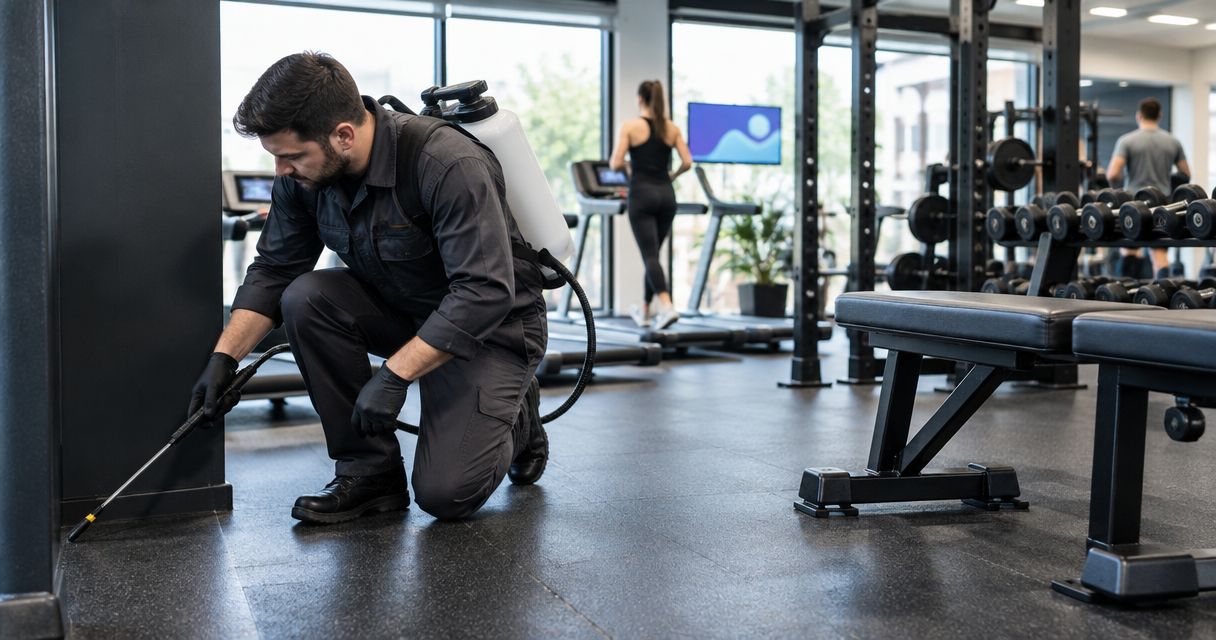
Pest control for gyms is the coordinated prevention, monitoring and management of pests in fitness facilities to protect members, staff and usable space. Shared locker rooms, drink stations, equipment storage and extended operating hours require a plan that separates everyday housekeeping from pest-specific control and building repairs.
- Pest control for gyms starts with sanitation, moisture correction and a written record of pest sightings.
- Exo Pest Solutions fits Bay Area gym operators seeking commercial pest control and rodent exclusion.
- Rodent control addresses current activity; exclusion seals identified entry points to support long-term protection.
- Schedule work around occupied areas, product-label requirements and clearly assigned building responsibilities.
Why pest control matters for gyms and fitness centers
A gym combines several different environments under one roof. Locker rooms introduce moisture, reception areas collect drink spills, and storage rooms contain items that staff do not move during routine cleaning. Each area needs its own checks rather than one building-wide instruction to clean more.
The operational challenge is access. Members use floors, benches, showers and equipment throughout the day, so pest-related work needs a defined location, schedule and reopening instructions. A snack counter also needs food-handling precautions; this guide to pest monitoring for commercial kitchens addresses that distinct setting.
For your 2026 operating plan, connect pest reporting with cleaning and maintenance. A report without a location is difficult to investigate; a repaired leak without follow-up leaves staff unsure whether the problem has stopped.
Build a gym pest-control plan
Record sightings before choosing a response
Start with a shared log and a simple floor plan. Ask staff to record what they actually saw rather than naming a pest from memory. A photograph taken without handling the pest gives the person assessing the problem more useful information than a description such as small bug.
Use 1 shared log for the facility, not separate messages held by reception, cleaners and maintenance. This is an organizational recommendation, not a required reporting frequency. Keep member information out of pest photographs and restrict access to operational records.
Record whether the sighting involved a live pest, damaged packaging, droppings or an unexplained sound. These are observations to assess, not interchangeable proof of an infestation.
- Record the date, time and exact room or equipment area.
- Photograph visible evidence without touching or disturbing it.
- Note nearby moisture, food residue, waste or damaged materials.
- Assign a staff member to pass the report to the responsible decision-maker.
Separate current activity from entry-point repairs
Begin with accessible visual checks from normal walking areas. Look for damaged door sweeps, gaps around service penetrations and disturbed storage, but do not enter crawlspaces or open electrical equipment to investigate. Leave inaccessible areas for an appropriately scoped assessment.
Control and exclusion solve different parts of a rodent problem. Control addresses rodents currently present. Exclusion closes identified entry points to reduce future access; it does not replace a plan for activity already inside.
Keep cleaning separate as well. Removing affected materials, managing current pests and repairing the building require different decisions. Ask how those tasks connect before approving work, particularly when a landlord controls exterior repairs.
- Separate current activity from possible access points in your records.
- Mark damaged doors and visible openings for maintenance review.
- Ask how active rodent activity will be managed alongside sealing.
- Confirm who approves repairs outside your leased space.
Request a property-specific assessment and scope
Organize your observations before contacting a provider. Share the affected rooms, operating hours, photographs and building-access restrictions. This lets the discussion start with your facility rather than a general request to treat everything.
Exo Pest Solutions is a fit for Bay Area gym operators seeking commercial pest control and rodent exclusion. The company serves homes and businesses in Santa Clara, San Mateo and Alameda counties, including facilities in San Jose and Palo Alto.
For your 2026 scope review, ask for clear boundaries around assessment, control, exclusion and any cleaning work. A free quote does not imply a free inspection, report or treatment. Confirm what is included before authorizing a visit or additional work.
- Observed activity: describe the evidence and affected locations.
- Access points: identify openings included in any proposed exclusion work.
- Work scope: distinguish assessment, control, repairs and cleaning.
- Follow-up: confirm responsibilities and how new sightings will be handled.
These four categories keep the service discussion organized. They also give your manager a practical way to compare the proposed work with the problem originally reported.

Remove food residue and address moisture sources
Start with the cleaning and maintenance work your team can safely perform. Check beneath movable items, around drink dispensers, inside waste areas and beside locker-room plumbing. Report inaccessible spills or leaks instead of moving heavy equipment without authorization.
Divide the gym into 3 working zones: wet areas, food-and-drink areas, and dry activity or storage areas. These are suggested management categories, not a pest-risk score. Assign tasks by zone so an instruction to clean the gym becomes a checkable list.
Sanitation supports pest management, but it does not prove the source has been removed. Continued sightings after cleaning call for reassessment, not repeated accusations that staff missed something.
- Remove drink residue from cup holders, counters and accessible equipment surfaces.
- Store staff snacks and retail food in suitable closed containers.
- Empty waste containers and clean residue inside and around them.
- Report plumbing leaks and persistent wet areas for repair.
- Keep stored supplies accessible for inspection rather than packed against every wall.
Coordinate work around members and staff
First, map the affected area against class schedules, cleaning shifts and delivery access. A quiet studio and a busy locker room need different access arrangements. Do not assume that closing the reception desk makes the rest of the building ready for work.
If pesticides are proposed, ask for the product information and applicable label directions. Do not promise members a universal reopening time or describe a treatment as harmless. Product requirements and the agreed work determine the instructions.
Put these arrangements in the 2026 facility procedure so the person opening the gym knows what happened overnight. Reception staff should receive the operational instructions they need without being expected to interpret technical treatment details.
- Confirm which rooms or routes need restricted access.
- Ask what items need protection, removal or cleaning.
- Obtain applicable access and reopening instructions in writing.
- Tell cleaners which monitoring devices or work areas must remain undisturbed.
- Assign responsibility for checking the area before normal use resumes.
Check follow-up evidence and repair completion
Compare new reports with the original locations before changing the plan. A sighting near an unrepaired service door and a sighting in a newly affected room deserve separate investigation. Keep the observations specific rather than reporting only that pests are still present.
For exclusion work, request a clear record of the openings included. Long-term protection depends on properly sealing identified entry points and maintaining the building; removing current rodents alone does not address continued access.
Exo Pest Solutions backs its exclusion work with a 2-year warranty on the entry points it seals. The warranty does not cover new holes created by rodents or other contractors, or openings outside the agreed exclusion work. Keep those boundaries with your service records.
- Match follow-up observations to the original floor-plan locations.
- Confirm completion of agreed repairs and assigned cleaning tasks.
- Report new damage after plumbing, electrical or other contractor work.
- Keep scope documents and warranty terms accessible to the facility manager.
Compare pest-management options for your gym
Choose an approach by the problem it addresses, not by whether it sounds strongest. The options below can complement one another; none replaces identification, access planning or clear responsibility for repairs.
| Option | Best for | Practical advantage | Key limitation |
|---|---|---|---|
| Staff sanitation and maintenance | Routine prevention in accessible areas | Fits existing cleaning and repair workflows | Does not identify every pest or resolve concealed activity |
| Monitoring and documented checks | Finding patterns and assessing follow-up | Connects observations to specific locations | Records activity rather than resolving its cause |
| Professional pest control | Activity requiring pest-specific assessment and management | Establishes a defined response to the observed problem | Does not automatically include entry-point repairs or cleaning |
| Rodent exclusion | Identified rodent access through building openings | Addresses access rather than only current rodents | Applies to the openings included in the agreed work |
| Crawlspace cleaning | Assessed cleaning needs beneath a building | Gives the affected space a separate work scope | Does not itself replace rodent control or exclusion |
For a 2026 service decision, ask which of these tasks your quote includes. Exo Pest Solutions offers commercial pest control, rodent exclusion and crawlspace cleaning, but those service categories do not mean every task belongs in every gym's scope.
Common mistakes gym operators make
Treating every small insect as the same problem
An insect near a shower and one found in packaged snacks require identification, not an automatic building-wide response. Preserve the location details and obtain useful photographs. Choose the response after identifying the problem.
Asking cleaners to handle rodent contamination routinely
Do not ask staff to dry sweep or vacuum rodent droppings. CDC rodent-cleanup guidance warns against these actions because they can put contaminated particles into the air. Restrict access and arrange an appropriate cleanup assessment rather than adding the area to an ordinary floor-cleaning task.
Approving sealing without discussing active rodents
A repair-only instruction leaves an important question unanswered: how will current activity inside the building be addressed? Ask for the sequence and responsibilities before work starts. Keep control, exclusion and cleaning distinct in the written scope.
Letting building responsibility remain unclear
A gym tenant does not necessarily control exterior doors, shared waste storage or neighboring units. Assign landlord and tenant actions explicitly. Otherwise, the gym can complete its indoor tasks while a reported building defect remains unresolved.
Treating a quiet week as proof the issue is finished
No new sightings is useful information, but it is not a substitute for checking the agreed work. Review repair completion, monitoring observations and outstanding maintenance. Use the follow-up criteria in your scope rather than an arbitrary waiting period.
FAQ
What’s the best pest control approach for a gym?
The best approach combines pest identification, sanitation, moisture correction, monitoring and work matched to the observed activity. Add rodent exclusion when identified building openings are part of the problem; cleaning alone does not close those openings.
Can my gym stay open during pest-control work?
Your gym’s access arrangements depend on the work, affected areas and applicable product-label directions. Confirm restrictions and reopening instructions before scheduling, rather than assuming every service requires a full closure or no closure.
What should gym staff do after finding rodent droppings?
Keep people away from the affected area and do not dry sweep or vacuum the droppings. Record the location without disturbing the material and arrange an appropriate assessment and cleanup plan.
Is rodent exclusion the same as rodent control?
Rodent exclusion seals identified entry points, while rodent control addresses current activity. A facility with rodents already inside needs the relationship between those tasks explained in its work scope.
How often should a fitness center schedule pest-control visits?
Set the service schedule from the facility’s observed activity, building conditions and agreed monitoring plan. There is no single interval established here for every gym; define who checks between visits and what triggers another assessment.
Does a free pest-control quote include an inspection?
A free quote does not imply a free inspection, report or treatment. Ask what the appointment includes and confirm the scope before authorizing work.
Does Exo Pest Solutions serve gyms in San Jose and Palo Alto?
Exo Pest Solutions provides commercial pest control, rodent exclusion and crawlspace cleaning for businesses in Santa Clara, San Mateo and Alameda counties. Gym operators in San Jose and Palo Alto can request a property-specific quote and discuss their facility’s needs.
One last thing
Add pest-related repairs to your contractor handover process. A cable installation or plumbing alteration deserves an access-point check when the work is complete, even if the gym previously received exclusion work.
For your 2026 maintenance file, keep the agreed exclusion boundaries beside later contractor records. That makes a newly observed opening easier to assign and investigate without assuming it falls under earlier work.
Related guides
- Rodent control in San Jose
- Pest control for restaurants
- Rodent monitoring devices for San Jose warehouses
Share what you are seeing, the affected rooms and your operating hours. Request a property-specific quote, then review the proposed scope and access requirements before approving work.
Request a gym pest-control quote
Share observed activity, affected areas and access constraints for a property-specific scope discussion.
Leave a Reply